- youtube
- bluesky

- Home
- About
- Costume Journal
- Membership
- Conference & Events
- Grants & Awards
- News & Social
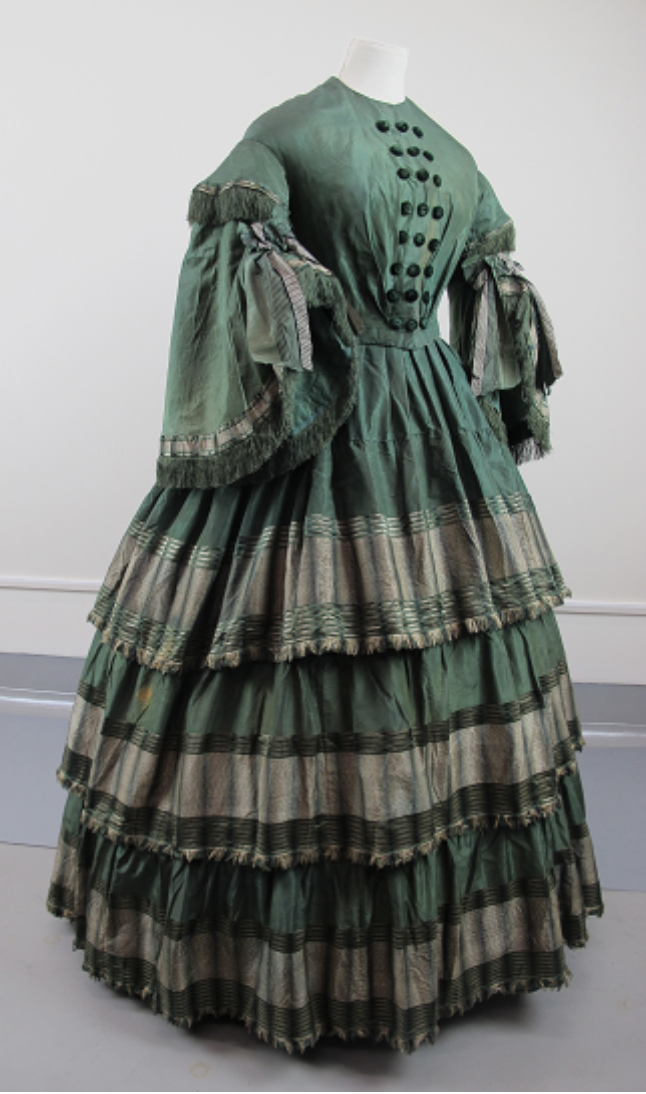
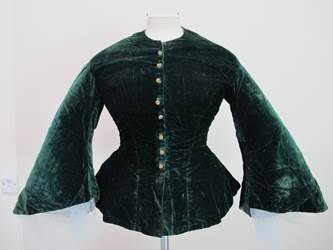
The inaugural Elizabeth Hammond Grant was made to Clydebank Museum and Art Gallery for the conservation and display of an 1850s dress and jacket in their exhibition, A Stitch in Time: the Story of the Sewing Machine, showcasing their nationally significant sewing machine collection and Singer archive.
A c.1830-40 green velvet jacket and c.1830-40 green silk dress.
An exhibition at the Clydebank Museum and Art Gallery, 18 February – 13 May 2017 By Laura MacCalman, Project Director, Heritage Team, West Dunbartonshire Council
Clydebank Museum & Art Gallery is a fairly new institution –it was established in 1980 by volunteers from the local community who set up the first museum. Over time the museum became part of the services of West Dunbartonshire Council. Clydebank was a town built on industry – the largest and most well-known industries in the town were the shipyards and the Singer Manufacturing Company’s factory. The factory came to Clydebank in 1884 and closed in 1980. When it first opened it was the largest purpose build sewing machine factory in the world, had the biggest four faced clock tower in Europe, at its production peak in 1913 it manufactured over 1.3 million sewing machines and employed tens of thousands of people from around the local area. When the industries began to close in the 1970s and 1980s, local volunteers decided to take action to ensure Clydebank’s industrial heritage was not lost. They approached the Singer Company in 1980 when they were in the process of closing the Clydebank factory and convinced them to donate the machines the company had in their Copyright and Patents Department to the new museum. Archive material followed, and so Clydebank Museum was established and the sewing machines and archive were its first collection.
In 2013, the Sewing Machine Collection and Singer Archive was awarded the status of ‘Recognised Collection of National Significance’ – meaning it is of national importance to Scotland in terms of the of the information it can provide on the industrial, social, economic and technological contribution to the nation (equivalent status in England would be a Designated Collection). Exhibitions held in the past relating to the Singer Collection focused solely on the Clydebank factory and Singer machines due to the local connections. However, the collection has sewing machines from 130 different manufacturers and I was keen more of these should be seen. I also wanted to tell the story of how the sewing machine came to be and the obstacles it faced before it became so widely accepted in all aspects of the clothing industry. In essence I wanted to look at the invention and development of the sewing machine against a backdrop of clothing manufacture and particularly dressmaking. Not only would this allow us to display a greater range of our machine collection, it would also allow us to display, for the first time ever, some of the Victorian dresses we have in the collection. We will be exhibiting three of our own Victorian pieces – a beautiful blue and taupe dress dating to the 1830s/1840s (with evidence that some of the material in the dress is earlier in date and has been reused) and the green dress and jacket which is being conserved thanks to the Costume Society Elizabeth Hammond Award. We are also borrowing four dresses from Glasgow Museums’ collections and we have a range of accessories from both our own collection and Glasgow's.
All these objects will be displayed alongside a range of sewing machines from our Singer Number 1 and the first British made sewing machines to early domestic machines and machines specially manufactured for shoe, fur and glove stitching. The green dress and matching jacket are actually part of a five part set – skirt, day and evening bodices, bertha collar and jacket. The dress (skirt and day bodice) and jacket were in need of the most conservation work and as such were chosen to be put forward for the EH Award. The provenance of the five piece outfit is not certain, but the assumption is that it once belonged to a member of one of the more wealthy families in the area in the mid-19th century. The jacket, of deep green silk velvet, is collarless, hip-length, and closefitting with flared three-quarterlength pagoda sleeves. The dress is made from green lightweight plain-weave silk. The tight-fitting bodice has pagoda sleeves, their hems decorated with a narrow band of striped silk in green, cream and black, and green silk fringe; the skirt is decorated with three silk flounces, edged with similar striped silk and fringe. We date the five piece set to the mid to late 1850s. The jacket and dress will be displayed in Room 1 of the exhibition along with our 1830s/1840s dress and our earliest sewing machines. The narrative for this room is the life of a seamstress prior to the invention of the sewing machine, its introduction, and first uses in the clothing industry. The dress and jacket represent the types of garments being made around the period that sewing machine use was becoming more widespread. The dress and jacket, which are hand sewn, represent the reluctance in the uptake of the sewing machine by dressmakers (the next two rooms discuss why this may be) and illustrate the styles and complexity of dressmaking in this period.
Janet Wood attended the opening at the Clydebank Museum and Art Gallery on 23rd February 2017. The Sewing Machine Archive is very comprehensive and the dress and jacket had a prominent position in the exhibition. Full credit was given to the Costume Society Elizabeth Hammond Award for f inancial assistance with the conservation of the garments. A leaflet available to exhibition visitors gave more details of the treatment carried out. Securing this Award enabled West Dunbartonshire Council to undertake professional conservation of an important Victorian day dress and jacket from the museum’s collection. Due to its age and through general wear and tear the day dress had suffered various small damages and some staining to the fabric. The delicate silk linings on the inside of pagoda sleeves of the jacket were worn, and the fabric had weakened along the seam fold. Both the dress and jacket were very creased. A significant amount of conservation work was required to prepare the outfit for exhibition. Not all historic garments were designed to be washed – washable undergarments were worn to protect delicate silks and velvets from body stains. For this reason, cleaning period textiles can be difficult, with the added risk of causing further damage. By testing the fabric of the dress and jacket the conservator found that the dyes used were water-soluble, which meant that the dress and jacket could not be wet cleaned. Further expert advice determined that dry cleaning was also too much of a risk. Instead delicate brushing and a specialist vacuum cleaner were used to lift stains. The badly-creased flounces of the skirt were too delicate to be ironed, so instead weights were attached to gently relax the creases.
Damaged and weakened areas of fabric were repaired and supported, especially the silk lining of the jacket sleeves. This was done by covering the silk with a fine nylon net dyed to match the colour of the silk. This intervention will prevent future damage to the silk. Finally, a petticoat was made to support the skirt of the dress and give it its proper shape while mounted on a tailor’s dummy for display in the exhibition. The conservator who worked on the project thanked the Costume Society for funding the project and commented that the conservation, particularly of the dress with its extensive mould, was unlikely to have been possible without the assistance of the award.
Image gallery