- youtube
- bluesky

- Home
- About
- Costume Journal
- Membership
- Conference & Events
- Grants & Awards
- News & Social
In 2010, Jennifer Rothrock at Brighton Museum and Arts Gallery, was awarded the Museum Placement Award.
Curator’s report: Martin Pel, Brighton Royal Pavilion and Museums
The exhibition, Dress for Excess, which opened in February 2011, celebrates the life of George IV and the Regency era through the dress of the period. The exhibition consists of period garments on open display across the Royal Pavilion with a separate room dedicated to George himself. To tell the story twenty-eight items were chosen. For display some of the items needed replica parts or in one case needed to be re-created completely. Through Amy de la Haye, Jennifer was recommended to me who took on the task with talent and enthusiasm.
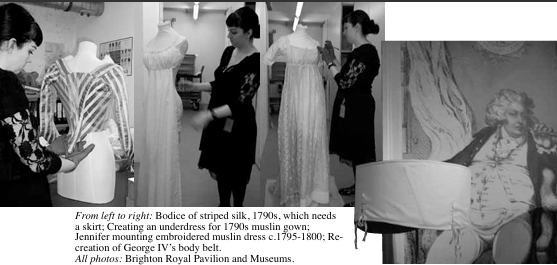
The first garment Jennifer made was a replica of George’s corset, otherwise and rather euphemistically known as his body-belt. The Museum of London holds an original pattern dating from 1824 for the corset but unfortunately the actual garment no longer exists. Jennifer copied the pattern, researched the history and re-created the corset. It has been incredibly popular with the public, not only giving a tangible example of his size in later life but also an insight into how he viewed himself. The public are often surprised and amused to learn George wore a corset!
Jennifer is currently working on another two items which will form part of the theme on neoclassicism and its influence on dress which are to be displayed from August 2011 until February 2012. (Although the exhibition is on for a year, items on open display will be changed after six months for conservation purposes.) The first is a silk underdress for a muslin gown, circa 1795-1800. The gown has delicate whitework embroidery all over, with a separate golden-coloured silk-ribbon ‘bodice’. The second item is a replica ‘skirt’ to complement a tight-fitting striped silk bodice, circa 1790s. On studying the bodice it appears that it originally would have also had an overskirt attached at the back; so Jennifer’s replica ‘skirt’ will consist of a petticoat with an overskirt.
The generous sponsorship by The Costume Society of Jennifer’s work has allowed Dress for Excess to display three very good pieces from Brighton’s collection. The whitework embroidered dress is the best example we have and is pivotal in telling the story of Regency dress, as is the bodice; the only one in the collection from the 1790s. George’s replica corset has to be the ultimate example of George dressing for excess! I hope Jennifer finds this work as beneficial in the long-term as Brighton Museum has found it in the short.
Jennifer Rothrock, Award Winner
The goal of my placement is to create three replica garments for the collection at Brighton Museum and the exhibition Dress for Excess. I will be working with Martin Pel, curator of Fashion and Textiles, from May 2010 until August 2011.
My first task was to visit the Museum of London and copy the pattern of a body belt worn by George IV. The construction of the belt as shown on the pattern was consistent with corsetry of the time, except for the method of joining the belt at the back. I questioned whether or not a body belt made for a large man such as George IV would have required a different method of closure. After some months of research Martin found a chapter in Robert Doyle’s Waisted Efforts on this specific belt and it answered our questions regarding buttons and loops, which was consistent with the pattern markings.
The next two projects are a shift and a skirt that complete garments being displayed in Dress for Excess in August. One of these is a Regency cotton dress that came to the museum without a shift. The dress embodies the Regency style, in fine Indian cotton, natural colour, with floral embroidery. My third project is a skirt for a gorgeous, striped silk bodice in the collection. We are researching the proper silhouette and fabric to go with this bodice.
Benefits from the Award
There are many curatorial debates about reconstructing period garments, whether it should be done at all or if done; how far do you go with period correct materials and construction for a garment that will be in a museum collection? I feel that as long as effort is made in sourcing and constructing the garments to a high standard, the benefits of replica garments outweigh any lack of authenticity. The most exciting part of this project is seeing my work on display in Dress for Excess and knowing that the garments I’ve created will be held in the dress collection for the long term.
Future plans
I recently completed an MA degree in Fashion Curation at London College of Fashion. I am passionate about historical clothing and hope to gain experience managing, curating and exhibiting dress collections in local and national museums. I also hope to continue creating replica garments. I am truly grateful for the opportunity the Museum Placement Award has given me, and for the time I’ve spent working with Martin Pel at Brighton Museum.
Image gallery