- youtube
- bluesky

- Home
- About
- Costume Journal
- Membership
- Conference & Events
- Grants & Awards
- News & Social
In 2010 the Daphne Bullard Grant was awarded to the Plymouth City Museum and Art Gallery archives for the conservation and display of one of Nancy Astor's most famous outfits, the suit she wore on her first day in Parliament in 1919 representing her constituency of Plymouth Sutton.
Nancy Astor was elected MP for Plymouth Sutton in November 1919, and became the first woman to take her seat in the House of Commons.
In 2010 Plymouth City Museum & Art Gallery celebrated its centenary year with a 'people's choice' exhibition entitled "Century". The objects within the exhibition were selected by visitors, groups that the museum works closely with and staff to display 'hidden treasures' within the museum's collection. One of the items chosen for display was the outfit worn by Lady Astor, the first female MP, on her first day in pariament in 1919. However, parts of the interior grey silk satin lining of the jacket had severely degraded and was too fragile to display. The 2010 Daphne Bullard Grant was awarded to Plymouth City Museum enabled conservation work to be carried out on this historically significant outfit, resulting in its safe conservation and display.
Lady Astor apparently deliberately chose an outfit for her parliamentary debut that would look demure and business-like. The early 20th century suit - affectionately referred to by Nancy as her 'parliamentary uniform' consists of a black double breasted jacket with a skirt, a cream silk blouse and a black velvet hat with a button.
The work to the jacket was carried out by Morwena Stephens ACR, Conservator of textiles and ethnographic artefacts. The jacket was surface cleaned using low-powered vacuum suction from a 'Museum-Vac' with a miniature upholstery nozzle. Heavyweight habutai silk and fine nylon net were colour matched to the grey silk lining using Ciba Geigy Lanaset dyes. The damaged areas were humidified to reduce creasing. This was done using a layer of blotting paper charged with deionised water and placed over an intermediate layer of 'Sympatex' (semi-permeable membrane) which covered the creased area. The ensemble was then covered with a layer of Melinex (polyester film). Once humidified the creases were manipulated and weighted with glass plates to dry. Patches of the dyed habutai silk were inserted under the areas of damage, a separate piece each side of a seam and pinned with entomological pins. Very fine polyester thread drawn from 'Stabiltex' leno weave fabric was used to secure the damaged areas onto the patches with laid thread couching.
Further protection was applied to the top centre back lining in the form of an overlay of dyed fine nylon net to offer some additional protection when the jacket is handled for display purposes. In order to be able to correctly align the patch support and the overlay along the top of the lining, the stitches securing the lining to the main fabric around the centre back of the collar were cut. Once the conservation support treatment had been applied the seam was re-stitched using fine polyester thread and following the original stitch holes as far as possible. The conservation work stabilised the suit jacket for it to be mounted and displayed in the Century exhibition (23rd October 2010- 29th Janaury 2011). The suit was displayed in a covered display case along with other items of costume and textiles. It was positioned to be adjacent to the painting Introduction of Lady Astor as the first woman MP, 1919 by Charles Sims RA (1873-1928) which depicts Lady Astor alongside Arthur Balfour and David Lloyd George wearing the very same skirt suit, blouse and hat.
Ths was the first time in 20 years that Lady Astor's sut had been on display in the museum and the first time it was displayed alongside the painting. The conservation work stabilised the jacket enabling it to be preserved for future displays including the 2013 exhibition 'Nancy: The Life and Times of Nancy Astor.'
The Astor suit was loaned to Westminster in 2018 for the exhibition: ‘Voice and Vote: Women’s Place in Parliament’. In the year that the UK Parliament marked the centenary of the Representation of the People Act (1918), this major exhibition in Westminster Hall used interactive features and historic exhibits to tell the hidden “her-story” of the UK Parliament.
The suit was studied in person by Hayley Gibbs who was commissioned to create a statue of Nancy Astor in Plymouth in 2019. The statue celebrates 100 years of women in Parliament, and was unveiled on Plymouth Hoe 28th November 2019.
When on display in the museum, the jacket and skirt were displayed alongside a painting commemorating her first day in parliament.
Information for this page was kindly provided by Alison Cooper, Assistant Keeper of Art, Plymouth City Museum & Art Gallery, 2011 and Terah Walkup, Curator, Economic Development, Collections Team Heritage, Art and Film, The Box, Plymouth.
Photo credit: Images courtesy The Box, Plymouth. Photographs by Guy Channing.
Image gallery
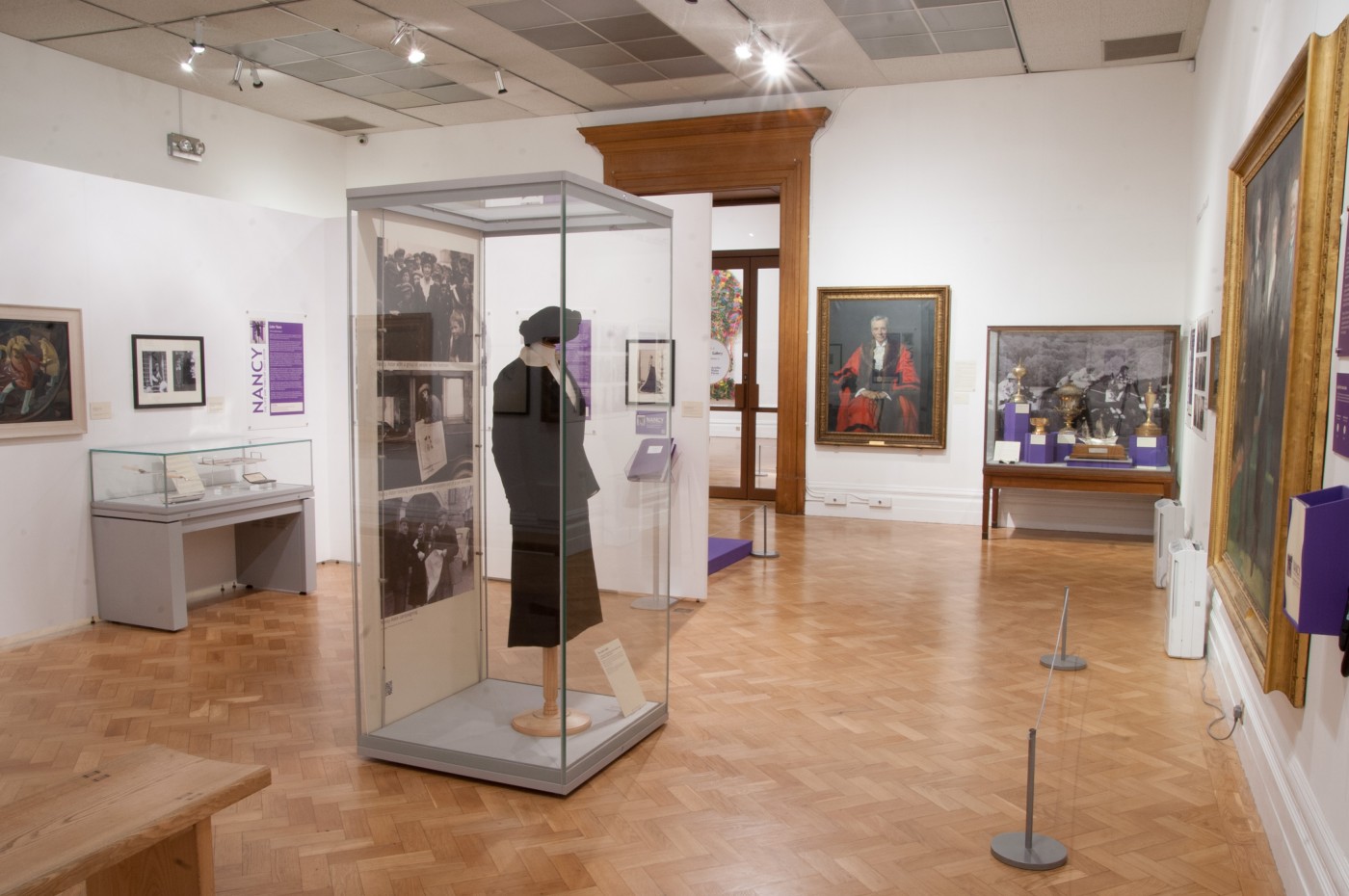
Image courtesy The Box, Plymouth. Photographs by Guy Channing.
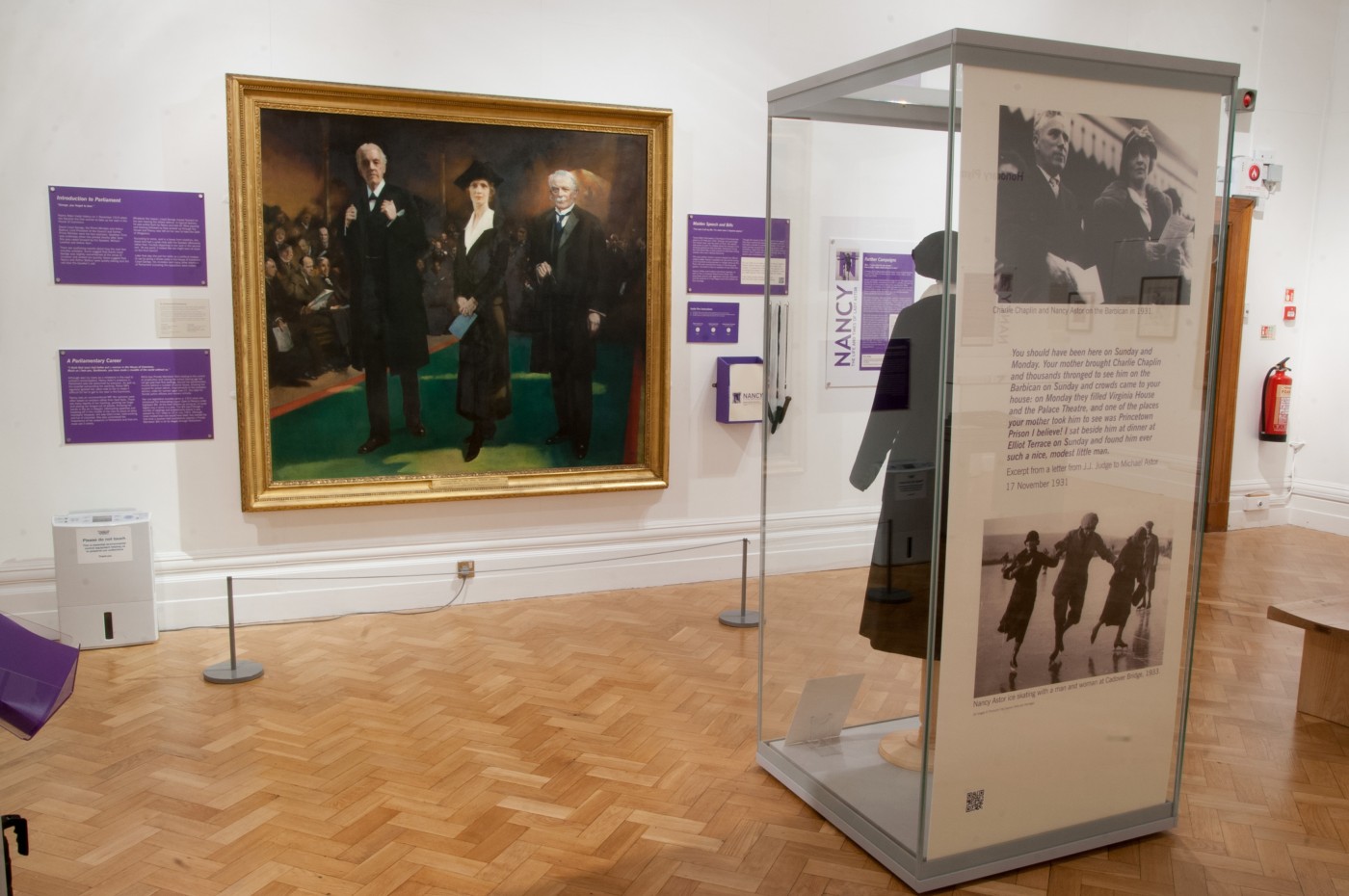
Image courtesy The Box, Plymouth. Photographs by Guy Channing.
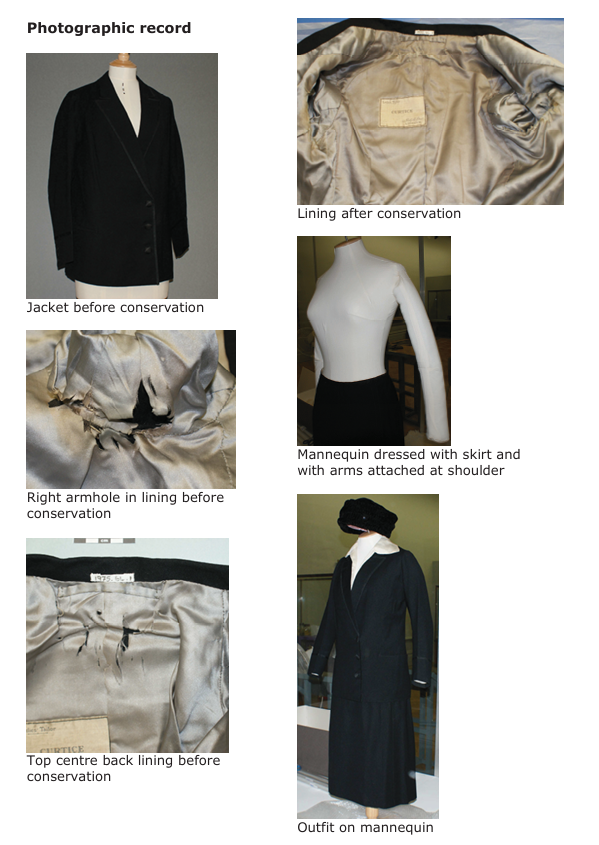
Image recording the conservation process. Courtesy Plymouth City Museum & Art Gallery
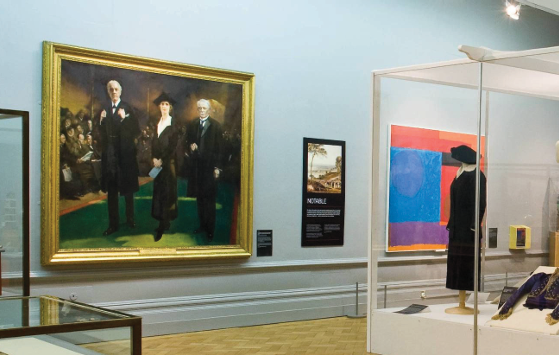
Photograph of Lady Astor's conserved suit on display in 2010