- youtube
- bluesky

- Home
- About
- Costume Journal
- Membership
- Conference & Events
- Grants & Awards
- News & Social
In this week's blog post, Costume Society member Jane Francis reviews The 90s: Art and Fashion exhibition currently on display at Tate Britain.
Fashion, Art and the last Offline Decade
The 90s are back, as if they never really left. It was a decade when fashion, art, music and nightlife blurred together, when disciplines collided and, for a brief moment, almost anything seemed possible. Perhaps this is why nostalgia for the period continues to exert such a strong hold over popular culture. It was also the last predominantly analogue decade, before smartphones and social media began documenting every gesture, outfit and encounter. As Tate Britain director Alex Farquharson observes in the accompanying publication, “The 90s was the last offline decade.”
For The 90s: Art and Fashion, Tate invited Edward Enninful, former editor-in-chief of British Vogue and one of the defining fashion voices of the period, to guest curate the exhibition alongside Tate’s curatorial team. Born in Ghana and raised in west London, Enninful was appointed fashion director of i-D at just 18, placing him directly inside the cultural moment the exhibition seeks to recover. His perspective is therefore not detached or retrospective, but personal. “What defined that period for me was not a single movement, but an energy,” he has said, describing “a refusal of hierarchy” across art, fashion and image-making. (The Guardian). Enninful recalls starting at i-D in 1991: “London felt raw, restless and open to reinvention . . . Art, fashion, music and nightlife collided — and a new creative language began to emerge . . . The 1990s was not defined by a single movement, but by a shared impulse to break down boundaries . . . That’s the energy I want to capture in this exhibition.”
That energy is the exhibition’s central proposition. Bringing together more than 100 works by almost 70 artists, photographers and designers, The 90s positions fashion alongside fine art, photography, film and club culture in an institution historically associated with the British art canon and, not insignificantly, the Turner Prize. Fashion is presented here as art, and art as fashion, but this ambitious collapsing of boundaries is both the exhibition’s greatest strength and its recurring problem.
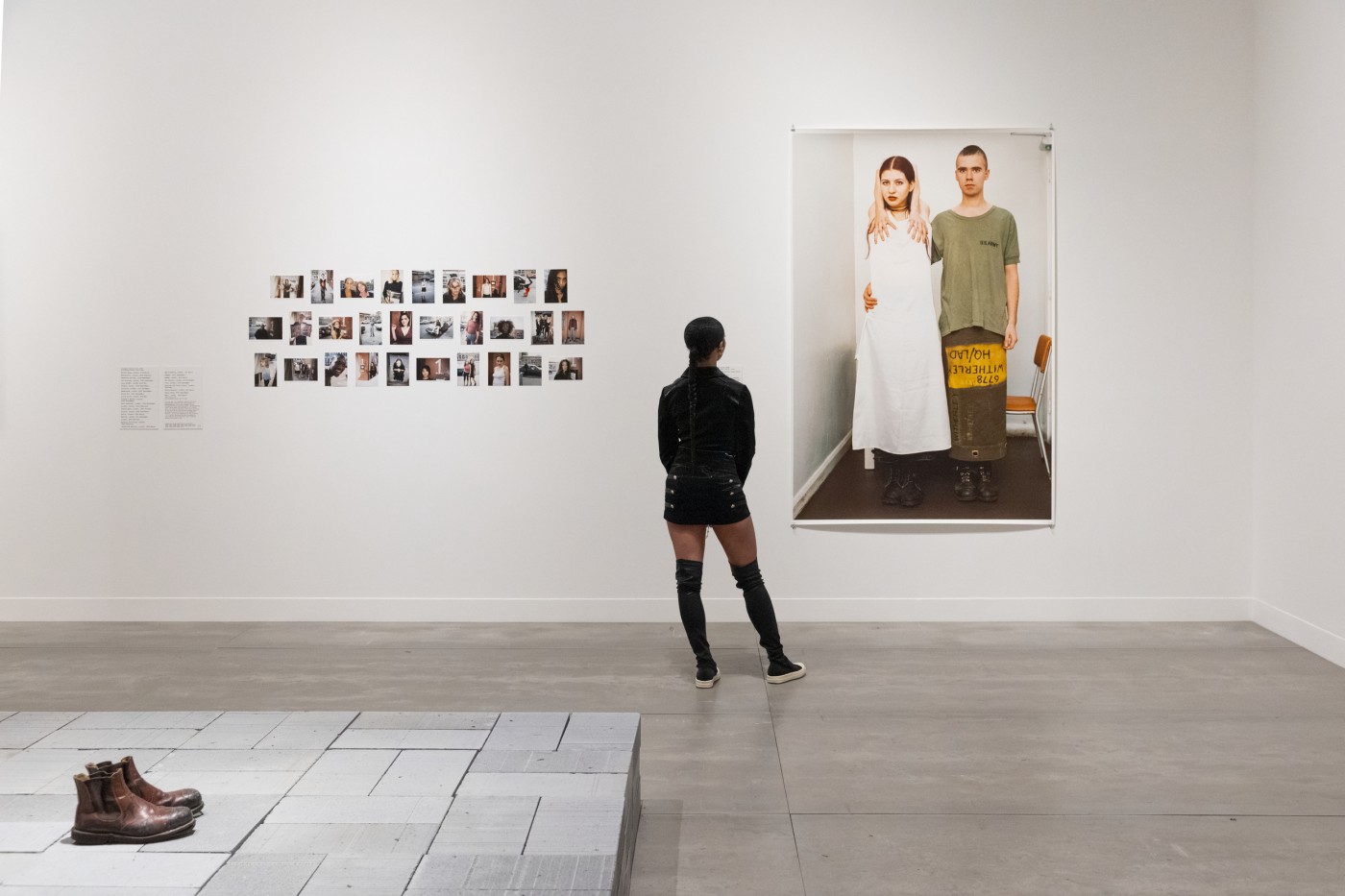
The 90s Art and Fashion at Tate Britain. Photo © Tate
The opening gallery launches the decade with Sarah Lucas’s 1-123-123-12-12 (1991), a pair of Dr. Martens boots fitted with razor blades at the toes. The title mimics a sound check, while the work itself transforms ordinary footwear into a defensive, almost aggressive object. Nearby, large-scale photographs by Wolfgang Tillmans and the work of a new generation of image-makers establish a mood of rawness and immediacy. Tate curator Helen Little describes the period as one when “art, fashion, music, and nightlife collided and exploded,” a useful phrase for the porous creative culture that shaped the decade.
Nowhere is this more apparent than in the photography of Corinne Day. Day’s anti-fashion approach deliberately dismantled the glossy perfection of the 1980s, replacing it with intimacy, vulnerability and apparent ordinariness. Her 1993 British Vogue editorial Under Exposure, photographed in Kate Moss’s west London flat, became one of the decade’s defining fashion statements. Moss appears in sparse interiors, wearing minimal underwear and simple cotton garments, surrounded by the unglamorous details of domestic life. The work attracted considerable controversy at the time, but its stripped-back documentary quality helped usher in the grunge aesthetic that would dominate much of 1990s fashion imagery.
In retrospect, the informality was perhaps as constructed as the polished glamour it replaced, yet Day’s work fundamentally shifted what fashion photography could look like. It suggested that authenticity, discomfort and imperfection could themselves become aesthetic currency.
The exhibition becomes darker in the section devoted to what might be described as body shock: gothic, grotesque and deliberately confrontational. Alexander McQueen’s work, with its armour-like bodices and animal references, sits alongside Jake and Dinos Chapman’s mutilated figures and Hamad Butt’s sculptures containing hazardous chemicals, works shaped by the fear and stigma surrounding HIV/AIDS. A standout is the dramatically lit red dress from McQueen’s 1998 Joan collection, encrusted with glass bugle beads over tulle, which anchors the room with an almost visceral intensity. Here, the optimism associated with the decade gives way to vulnerability, anxiety and bodily threat.
This is important because the 1990s were never simply the carefree decade of Cool Britannia. The exhibition addresses systemic racism, postcolonial identity, LGBTQ+ rights and economic precarity, reminding us that many of the questions being asked then remain unresolved now. Enninful himself argues that the decade established conditions that remain with us, particularly around “visibility, access and who gets to be seen.”
A quieter gallery devoted to minimalism offers a welcome pause. Two photographic works by Nick Knight for the September 1998 issue of Dazed & Confused, featuring Paralympian Aimee Mullins and dancer David Toole, were particular highlights. Guest edited by Alexander McQueen, the Fashion-Able issue challenged prevailing assumptions around beauty, embodiment and who fashion was for, with designers invited to create or supply clothing for disabled models. In retrospect, the project anticipated many of the conversations around disability, inclusion and representation that continue to shape fashion today. Knight later described it as “one of the most important shoots I’ve done.” From here, the exhibition moves into the work of Hussein Chalayan, another highlight. His conceptual practice has always moved between clothing, performance, architecture and political commentary, and the inclusion of pieces from After Words is especially significant. First staged at Sadler’s Wells in 2000, the collection responded to migration, displacement and the experience of leaving home. Furniture became clothing: chair covers transformed into dresses and, most memorably, a hand crafted mahogany coffee table became a shapeshifting wearable skirt.
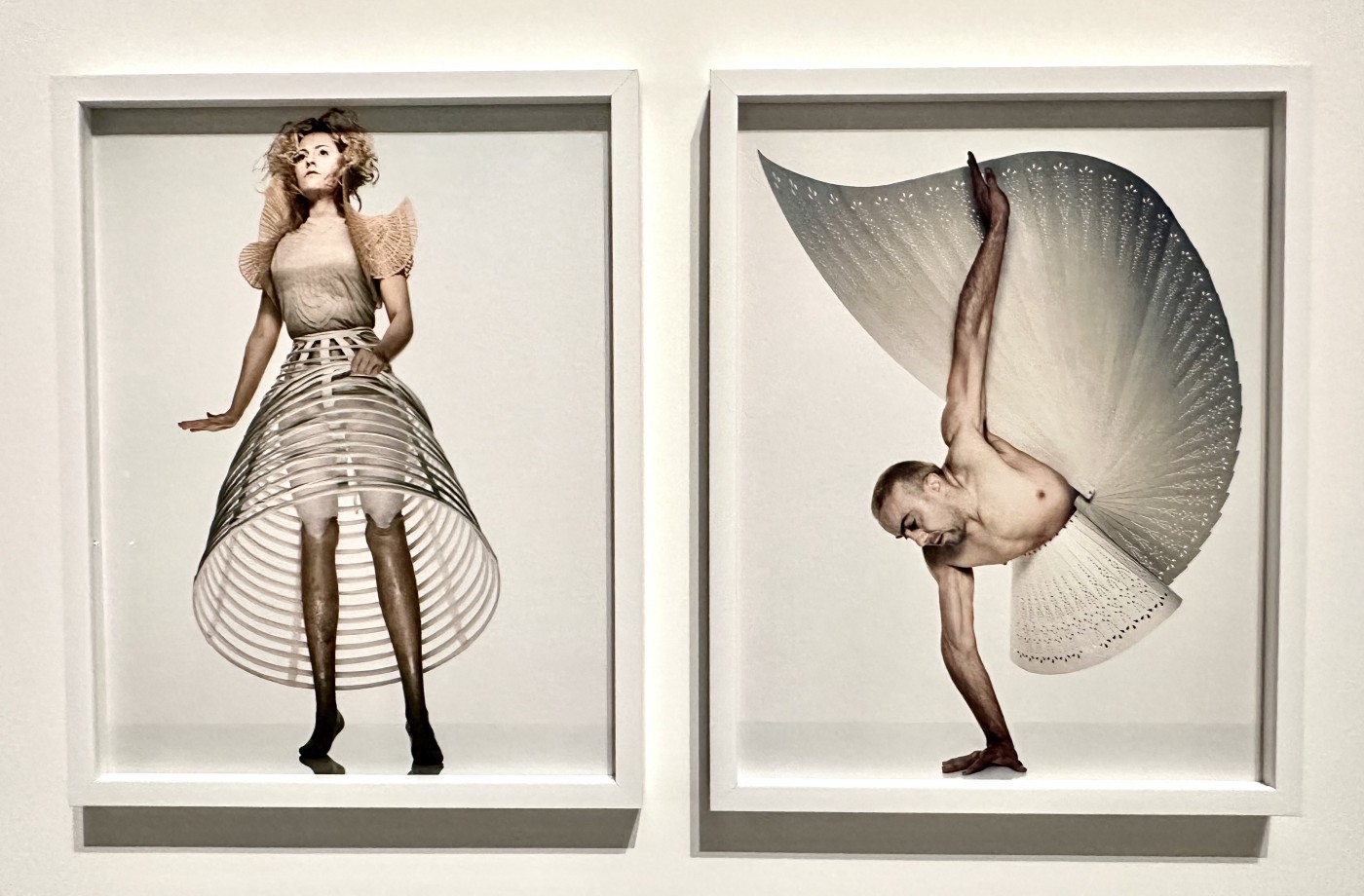
Nick Knight (Photographer) Amiee Mullins (Model) David Toole (Model) for Dazed & Confused1998. Image © Jane Francis
I first encountered After Words at Sadler’s Wells in 2000 and the experience has stayed with me ever since. The drama of the performance came from watching domestic objects mutate around the body, turning ideas of home, memory and forced mobility into something physical and immediate. At Tate, however, the mahogany table piece is displayed largely as an isolated object. Without the body, movement or sufficiently strong contextual staging, much of its meaning disappears. For a work so dependent on transformation, its presentation here feels surprisingly static. This is one of the exhibition’s recurring weaknesses: fashion objects are sometimes asked to survive the gallery without enough consideration of how radically their meaning changes once removed from performance.
DIY Energy to Institutional Memory
The fashion element brings together many of the decade’s best-known British names: Alexander McQueen, Hussein Chalayan, John Galliano, Ozwald Boateng, Stella McCartney and Vivienne Westwood. There is no question that these designers helped redefine international fashion. Sarah Burton recalls in the accompanying publication that “we created something out of nothing,” describing the determination and lack of commercial calculation that characterised the era.
This is precisely where the exhibition feels unexpectedly narrow. In a decade remembered for independent practice, improvisation and DIY culture, relatively little attention is paid to lesser-known designers, small labels, stylists and makers who operated outside the major fashion system. The now-canonical names dominate. A graduate piece by Stella McCartney, positioned so high that it is difficult to examine properly, reinforces the sense that fashion occasionally receives less sensitive display treatment than the art surrounding it.
Vivienne Westwood’s Anglomania collection of Autumn/Winter 1993 is particularly effective in dialogue with Yinka Shonibare’s The Swing (after Fragonard) (2001). Westwood’s tartan, kilts, riding hats and exaggerated eighteenth-century silhouettes rework British and French histories through fashion. A tartan wool ensemble blends references to upper-class English and Scottish country attire—heavy wool, kilts and riding hats—with eighteenth-century French silhouettes. Her practice repeatedly mined the past in order to destabilise the present, using historical dress not nostalgically but critically.
Shonibare’s The Swing, based on Fragonard’s 1767 Rococo painting, similarly unsettles history. His headless female mannequin wears an eighteenth-century-style gown made from brightly patterned Dutch wax fabric, a textile whose complex history connects Indonesia, the Netherlands, Britain and West Africa. By replacing the original aristocratic figure with a body marked by histories of empire and trade, Shonibare reframes Fragonard’s image of privilege and leisure through colonialism and global exchange. The pairing with Westwood is one of the show’s more convincing moments, because fashion and art genuinely illuminate one another rather than merely occupying the same room.
The decision to end with Shonibare’s 2001 work also makes sense conceptually, even though it falls technically outside the decade. It demonstrates how ideas formed in the 1990s continued into the new century: questions of Britishness, race, class, identity and cultural ownership did not end in 1999.
This is ultimately where The 90s: Art and Fashion succeeds and frustrates in almost equal measure. Its ambition is considerable. It attempts to reconstruct not simply a decade but an ecosystem in which artists, photographers, designers, musicians and club cultures existed in unusually close proximity. As Sarah Lucas recalls in the accompanying book, “We were our own audience,” capturing something of the intimacy and self-belief of the period.
In trying to encompass art, photography, fashion, politics and nightlife, the exhibition often sacrifices depth for breadth. The thematic groupings can feel episodic, and the show sometimes becomes less a history of the decade than a history of the decade seen through Enninful’s own experience. There is nothing inherently wrong with that—his lived perspective gives the exhibition much of its authority—but the result is inevitably selective.
For those of us who remember the period, the 1990s were a time when contemporary art suddenly became visible, the Turner Prize became mainstream news, YBAs dominated cultural conversation, Manchester became a cultural hub, Britpop emerged, and British fashion produced some of its most radical designers. Music, clubs and magazines became laboratories for new identities. Much of that energy is present here, but never quite fully captured.
I left the exhibition unexpectedly nostalgic, but also wanting more: more fashion, more independent designers, more DIY culture, more from the artworks, more context, more optimism and perhaps more mess. The exhibition successfully reminds us why the decade still matters, but it also reveals the difficulty of institutionalising a period whose defining characteristic was its refusal to remain within institutions in the first place.
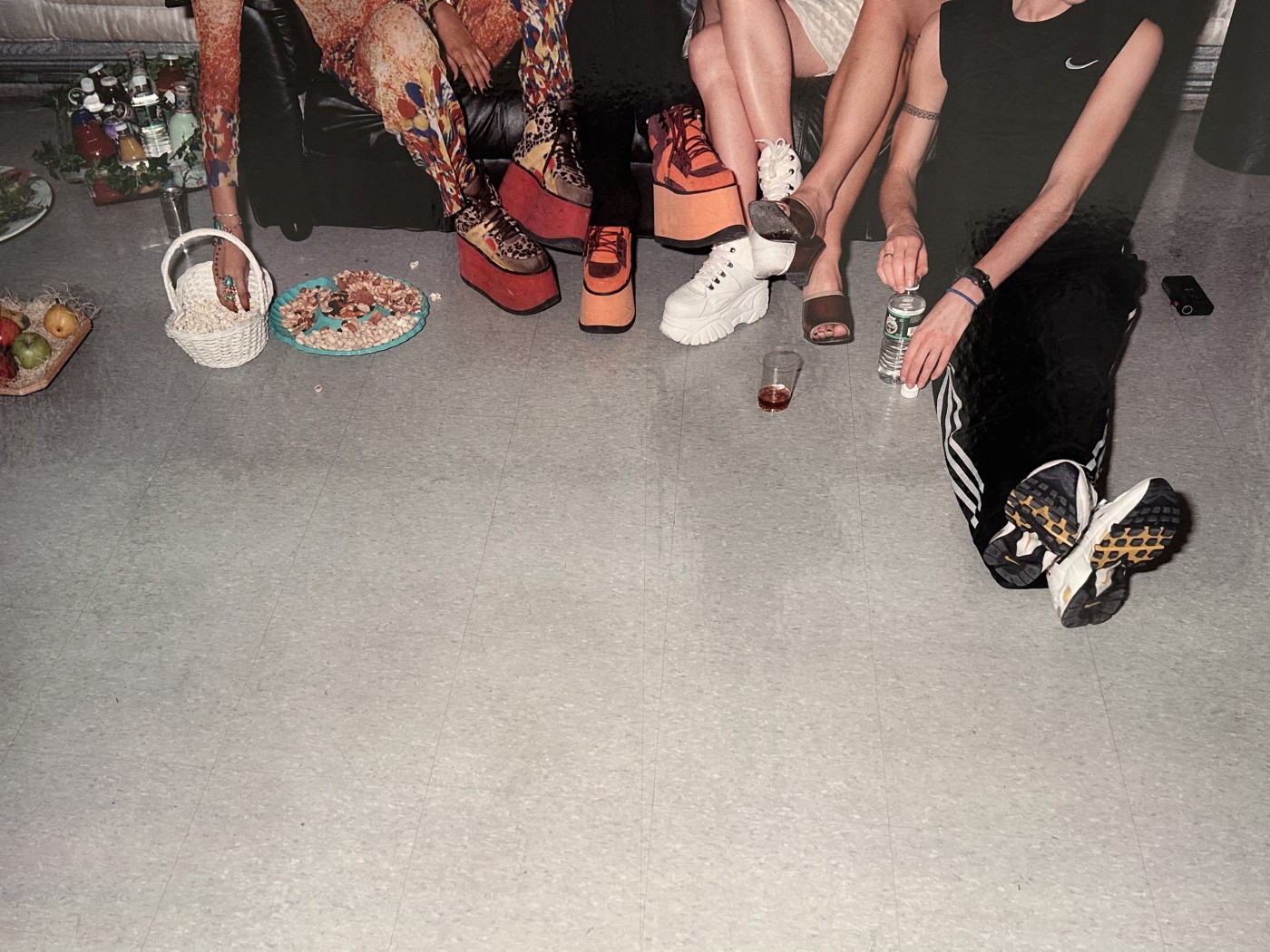
Spice Girls (Mel B, Geri Halliwell, Emma Bunton. Victoria Beckham, Mel C. 1997 © Nigel Shafran
The exhibition is accompanied by a comprehensive Tate publication; The 90’s Art & Fashion. Edited by Edward Enninful, this book captures the raw electricity of a changing British psyche at the intersection of art and fashion. It brings together a riotous mix of photography, painting, installation and couture from groundbreaking artists, photographers and designers including Alexander McQueen, Corrine Day, Damien Hirst, Sarah Lucas, Vivienne Westwood, Chris Ofili, David Sims, Tracey Emin and Jurgen Teller. Through first-hand reflections from a chorus of iconic and trailblazing figures such as Steve McQueen, Yinka Shonibare, Normski, Gillian Wearing, Wolfgang Tillmans, Jarvis Cocker, Sonia Boyce and Stella McCartney, the catalogue explores how these visionaries designed – and defined – the decade.
The 90s: Art & Fashion is on at Tate Britain, London, until 14 February 2027.
Jane has reviewed other exhibitions globally, including others in London such as the current V&A Schiaparelli retrospective, which you can revisit on our blog.