- youtube
- bluesky

- Home
- About
- Costume Journal
- Membership
- Conference & Events
- Grants & Awards
- News & Social
In this week's blog post, Central Saint Martins Fashion Histories and Theories student Ella Petryszyn recounts her experience assisting research and curation for the Zandra Rhodes: Archive Unfolded exhibition currently on display at De Montfort University, Leicester.
On 26 September, De Montfort University is set to open Zandra Rhodes: Archive Unfolded, the free to visit multi-site exhibition decorating the university campus in Leicester until 16 January, 2027. It is as much a pleasure to recount the makings of our exhibition here as it was to be involved as the assistant writer, researcher and curator over these last twelve months. As a student currently studying Fashion Histories and Theories at CSM, there's nothing quite like working amongst Zandra’s colossal fashion and textile archives, which are now largely split between her London studio and the Special Collections at De Montfort University. Zandra Rhodes: Archive Unfolded was first ignited to commemorate this generous donation of materials from the Zandra Rhodes Foundation, whose number one mission is to encourage the creatively inclined to interact with and learn from the designer's seminal body of work.
I’ve just returned from the exhibition build, which was an intense week of making lists, calling meetings, watching colourful painted walls dry, and constructing Rhodes’ personal collection vintage Adel Rootstein mannequins, who stare back at you expectantly, waiting to be dressed and wigged. Rootstein and Rhodes were great friends, both gifted with the rare ability of immortalising the youth culture of their time into mesmerising dresses and fiberglass forms. Each mannequin has her own distinct personality, and carefully detaching and reattaching every arm, leg and torso always proves to be quite the workout! My first experience in setting up an exhibition of this scale was last year at The Holburne Museum in Bath, for Zandra Rhodes: A Life in Print, a fabulous display of the designer's hero prints, curated by Rhodes and Rosemary Harden, who is one of the wonderful trustees of the Zandra Rhodes Foundation.
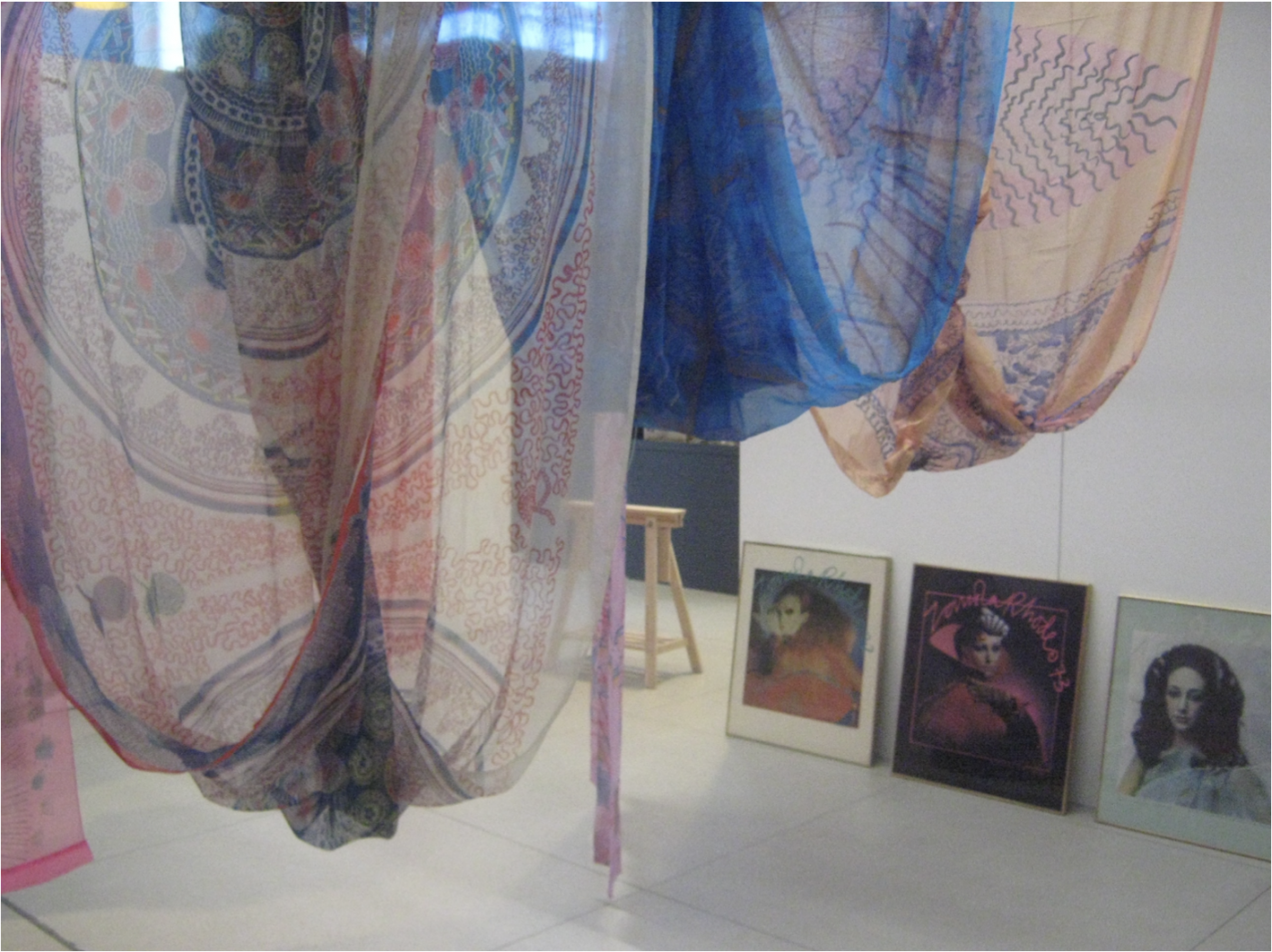
Building A Forest of Banners at De Montfort University Image by Ella Petryszyn, 2026.
An attempt to summarise Rhodes’ entire catalogue of donations and artistic output into one exhibition would be one done in vain. Our display is therefore directed by several key themes spread across three locations; the DMU (De Montfort University) Museum, the Gallery and Trinity House, where student translations of the archive will be opened up to the public. Within the Gallery space are Rhodes’ kaleidoscope of screen-printed textile banners, promotional posters from past collections, photographic transparencies, her collaboration licences and physical recreations of her design process tables. Just across the campus at the DMU’s on-site Museum, an in-depth exploration of Rhodes’ previously unseen 1983 Autumn/Winter Mediæval Collection has been presented amongst De Montfort's own medieval past – the ancient arches of the Church of Annunciation – first uncovered in 1935 and carefully preserved ever since.
Challenging what truly constitutes as an archive has always danced across my mind, a musing which was only amplified during my time spent in the stretches of Rhodes’ design space. Perhaps her studio is better described as a life-size cabinet of curiosities; you could spend an eternity exploring and unpacking her trunks of papers and dresses and printed chiffons only to require another eternity to process what you’ve just uncovered. Rhodes’ gradual accumulation of textiles and trinkets holds meaning and memories far more complex than a predetermined or linear history, as I like to believe the home and its objects arranged within function as an autobiographical roadmap which cannot always be contained or controlled.
The Zandra Rhodes Foundation has thus dedicated itself to cataloguing and preserving this life-force which lives and grows amongst the Zandra Rhodes studio, initiating projects like Zandra Rhodes: Archive Unfolded and Zandra Rhodes: A Life in Print exhibition to promote public learning from their discoveries. You can find frequent updates of the team's findings via instagram at @zandrarhodesfoundation, including the latest scans of Rhodes’ colour transparencies, her chosen format of personal and professional photographic documentation. An arrangement of enlarged high-resolution transparencies (dating from 1964–present day) awaits visitors at the entrance of the main Gallery at De Montfort University, with additional original Mediæval Collection transparencies found within the campus Museum.
In DMU’s glass-walled Gallery space now sits a timeline of Zandra Rhodes’ design licenses. Spanning across time, the pleated undergarments and robes from the designers' very first collaboration with American lingerie giant Eve Stillman have been presented alongside fashion accessories from Rhodes early 2000s to present day pairings with highstreet tycoons including Topshop and IKEA. A personal highlight of mine, found within this corner of the exhibition, are the wiggle-printed platforms and pumps Rhodes created with iconic shoemaker John Fluevog. One day I’ll get my hands on a pair, but for now they now sit between mannequins dressed in Rhodes-ified Wallis and M&S dresses.
Contemporary and accessible reimaginings of Rhodes’ archival print compositions such as the IKEA twenty-six piece collection and her illustrative book covers commissioned for Penguin Book’s 75th Anniversary (also on display as apart of Zandra Rhodes: Archive Unfolded), have allowed the magic I first experienced as an adolescent stepping into Rhodes’ penthouse for my week-long summer internship to be universally shared and experienced in the homes of individuals worldwide. I, like so many, have become besotted by Rhodes’ innate ability to bring beauty into the often dull or neglected design details of everyday objects. Her rainbow-coloured reality, which I’ve had the joy of helping present to the world on two occasions now, rings back to ideas from the English Arts and Crafts Movement. Beginning during the late 19th century, its founders rejected the disconnected attitudes and negative effects of industrialism, instead placing value on decorative techniques and traditional craftsmanship. This encompassed the manufacture and ornamentation in all design modes; from architecture to metalwork, ceramics, furniture, jewellery and textiles.
Everything Rhodes’ touches doesn't exactly turn to gold, but it gets close enough, and always receives a vibrantly decorated make-over reminiscent of those likeminded pioneers of the past. The idealistic creative forces of the Arts and Crafts Movement looked to the past for their artistic, social and intellectual aspirations. Whilst Rhodes’ seasonal collections largely revolved around her travels and contemporary surroundings, the Autumn/Winter 1983 Mediæval Collection was a rare case of her work also finding its core inspiration in English days gone by.
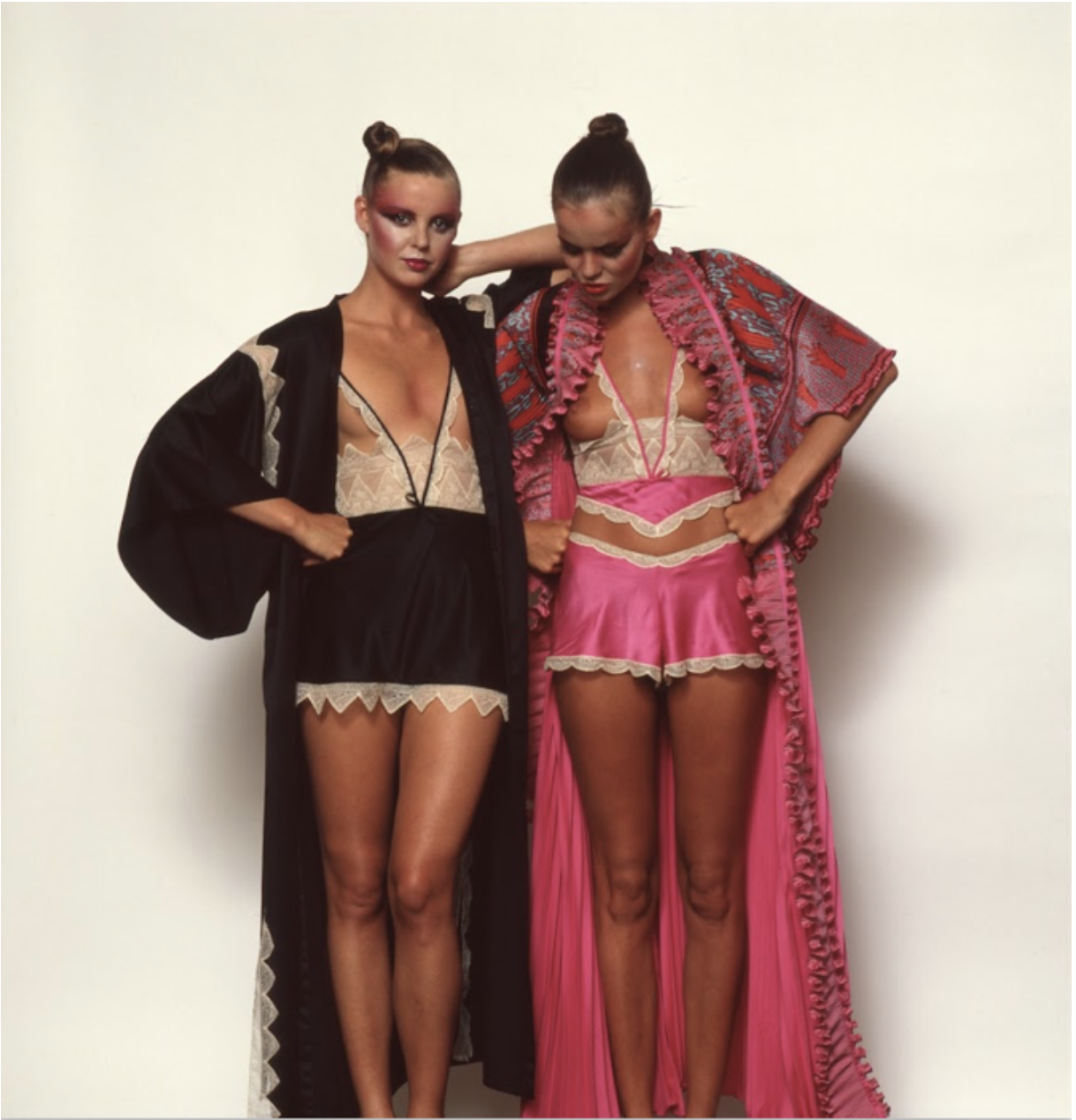
Zandra Rhodes x Eve Stillman
Image by Clive Arrowsmith, 1977.
Explored in great depth for the first time at De Montfort's Museum, we have curated the preserved memorabilia to follow Rhodes’ original order of working – from contextual research found in books and Medieval illuminations prompting her very first sketches to lookbook and runway photography of models floating down the catwalk by the celebrated Australian photographer Robyn Beeche. The far-right corner of the room centers the designer's skillful screen-printing process as fabrics laboriously become finished garments. Under the expert attention of Dame Zandra Rhodes, a single motif can be repeated and reconsidered a hundred times over. In her Medieval garments, she builds a fantastical reinterpretation of the period by embellishing lilac and cream chiffons with intricate beaded hemlines and giant paisley or frilly circle prints. She also applied leather and suede manipulations to this collection; punching, pinking and printing directly onto the materials which were then incorporated into knitted and tartan daywear ensembles with matching headpieces designed in collaboration with the esteemed milliner Stephen Jones.
On the opposite side of the Museum we have outlined the key makings of a fashion show. The Mediæval Collection epitomises the glitz and glamour so often associated with 1980’s style, specifically through the theatrical lens of Zandra Rhodes and her fellow contemporaries. Her original presentation was held at Pillar Hall in Olympia, London, soundtracked and choreographed by Derek Jarman, the late artist, gay rights activist and trailblazer of queer cinema. Rhodes’ gave great consideration to each and every aspect of a runway, from her fan-shaped invitations to how the music and movement of the models could reinforce the overall effect of her ensembles.
Since their very first meeting in 1972 at his inaugural queer beauty pageant titled Alternative Miss World, sculptor Andrew Logan and Zandra Rhodes have remained close friends and collaborators. Logan donated extensive ephemera from his Alternative Miss World archive to DMU’s Special Collections in 2023, including film reels, letters, books, sketches and costumes. Inspiring Rhodes’ to follow suit with her own archival records, it's romantic to imagine the two practitioners' memorabilia reuniting in their retirement at De Montfort University. For The Mediæval Collection, no look was complete without a mirrored mosaic and glass belt or brooch courtesy of Andrew Logan. A selection of his jewellery which was featured across Rhodes’ seasonal collections from the 1970s onwards is now displayed at Zandra Rhodes: Archive Unfolded, alongside Logan’s extravagant Mirrored Moon and Sword stage props, used to dress The Mediæval Collection stage at Pillar Hall in 1983.
I could pour over the details, significance and beauty of each and every object and obstacle we’ve encountered in the making of Zandra Rhodes: Archive Unfolded, but I’ll leave the rest unwritten, ready for visitors to make up their own stories. All that's really left to say is if you find yourself in or around Leicester during the cold and cloudy upcoming months, a trip to De Montfort University can promise to return some sunshine and light into your life through the dynamic textiles and techniques of the one and only Dame Zandra Rhodes. Plan your free visit today!
With many thanks to Zandra Rhodes, Lottie McCrindell, Rosemary Harden, Piers Atkinson, Lucy Budgen, Sheshan Duong, Peigi Urquhart, Lulu Collins, Emily Ash and the wonderful De Montfort University Team for all their invaluable help and guidance in the unfolding of our exhibition.
Zandra Rhodes: Archive Unfolded is on display at De Montfort University, Leicester, until January 16th 2027.
To discover more about the work of Zandra Rhodes, revisit Studio Manager and Costume Society member Lottie McCrindell's review and conversation with Rhodes herself during the 2025 Dress Poetics exhibition on our blog.