- youtube
- bluesky

- Home
- About
- Costume Journal
- Membership
- Conference & Events
- Grants & Awards
- News & Social
The Museum Work Experience Grant 2025 was awarded to Elizabeth (Lizzie) Turner, a MA student at the University of Winchester, for a project with Petersfield Museum and Art Gallery.
Petersfield Museum and Art Gallery worked with Elizabeth (Lizzie) Turner, a student at the University of Winchester studying towards an MA in Cultural Heritage and Resource Management, to prepare for display objects for two temporary art exhibitions opening in 2026. Lizzie collaborated with Museum staff on research, conservation reporting, photography and mounting. Lizzie audited these items to ensure accuracy and identify any overlooked pieces.
Following this, approximately seven to ten items will be selected for the exhibition and prepared for display. Additionally, exhibition text, labels and a longer publication for the museum's website will be created. This will significantly support the Museum by updating collection details, providing new research, condition reports and photography, ultimately enhancing the accessibility of our Fashion collection.
Lizzie commenced her MWEG experience in August.
This is her full report upon completion of her placement:
With the funding from the Costume Society I was able to undertake a collections audit at Petersfield Museum and Art Gallery exploring their holdings of 1920s garments.
The intention behind the audit was to understand the extent of their 1920s fashion and textile collection and its general condition with a view to curating a display of garments to complement an upcoming exhibition on Petersfield in the 1920s.
Most of the garments have had multiple previous lives. First worn by family members and teachers of Bedales school, they were then donated to the school’s drama department and rented out to amateur dramatics societies, before finally being donated to the museum in 2007. This provenance made the condition reporting and dating process particularly interesting, untangling what was a modern alteration or repair from the original garment. Evidence of wear provided a fascinating glimpse into the unknown characters and theatrical productions each garment had gone through - slight bead loss where a handbag was worn or a patch of crushed velvet from hands holding onto coats while no doubt nervously waiting in the wings. All of this adds to the garment’s history and the practice of reusing and repurposing antique textiles still persists in current film and tv productions.
Although I have experience working with 18th and 19th century clothing, the Costume Society placement allowed me to broaden my knowledge in 20th century materials and construction processes, introducing me to early plastics and machine-sewn factory finishes. Combining this material knowledge with the social history of the time allowed me to find broader social changes reflected in each of the garments. This ranged from a dress explicitly designed for the new dance styles of the 1920s and a garment that reflected the struggle for women’s equality across two countries linked by colonialism. Being able to do this research and contribute to the final object selection also gave me more confidence in my curatorial skills and knowledge.
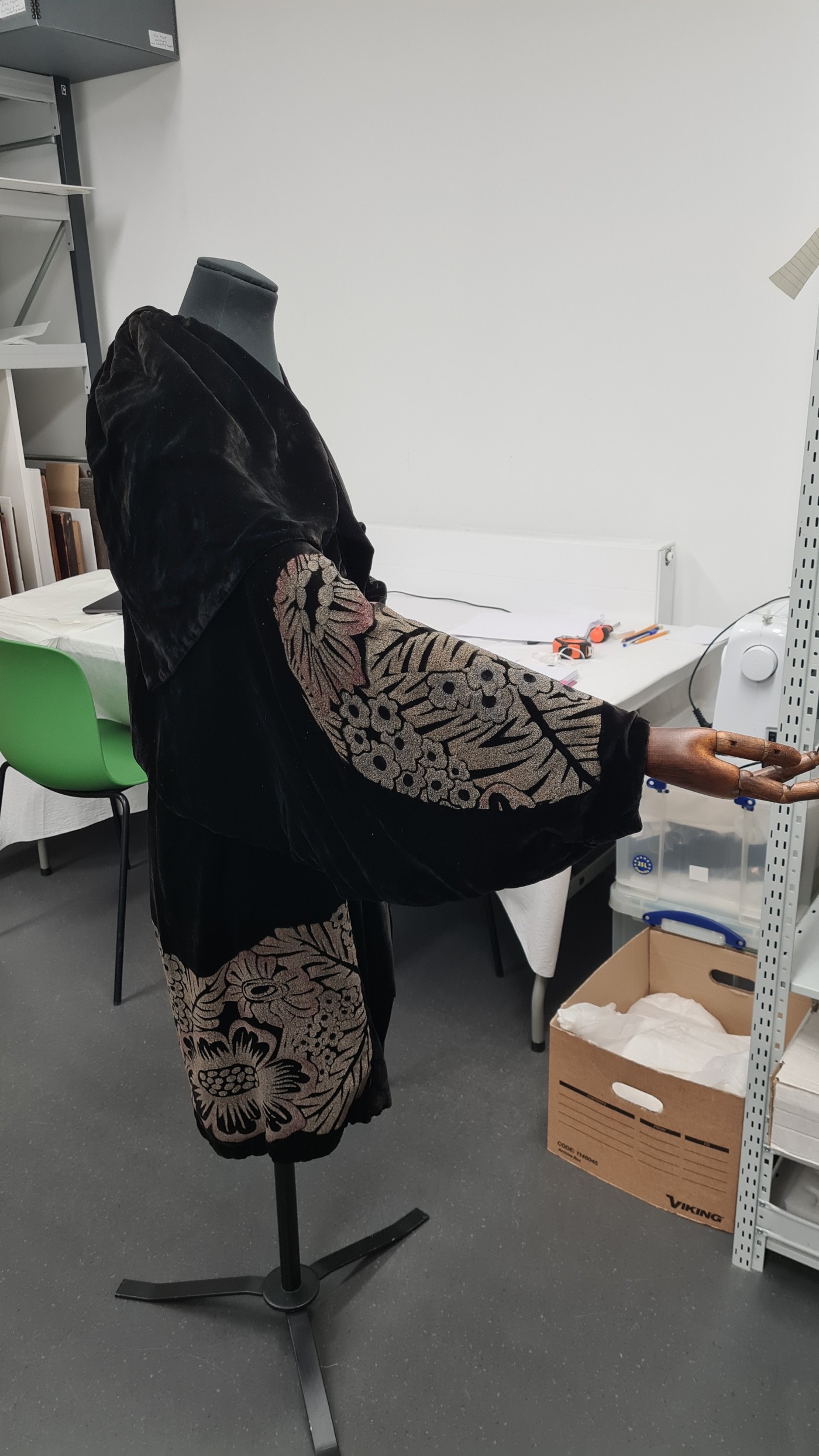
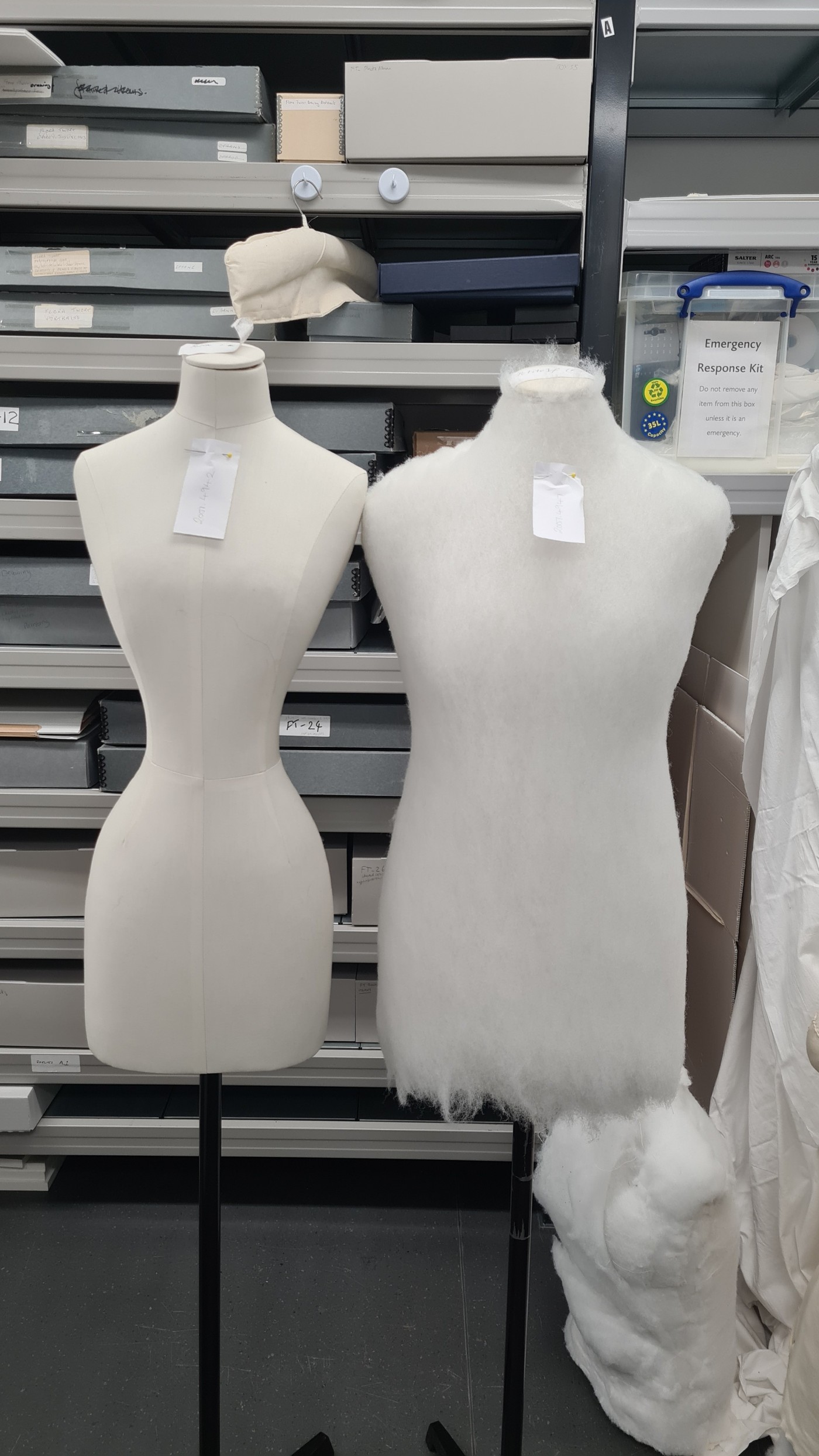
The placement also allowed me to get more hands-on with the collection and mount some of the garments selected for display. I have prior textile-mounting experience but working with the relatively columnar forms of the 1920s was a new experience and a steep learning curve. However, part of this challenge also led me to develop a different construction method for one of the jersey covers, avoiding any visible seams in the deep armholes.
I am very grateful to the Costume Society for this experience. The final outcome will be an exhibition opening at Petersfield Museum and Art Gallery, 29 April 2026.
Image gallery