- youtube
- bluesky

- Home
- About
- Costume Journal
- Membership
- Conference & Events
- Grants & Awards
- News & Social
In this week’s blog post, Costume Society member Dolla Merrillees reviews two parallel exhibitions drawn from the fashion archives of designer Azzedine Alaïa, at the Fondation Azzedine Alaïa (until 24 May 2026) and La Galerie Dior (until 17 May 2026).
Tunisian-born couturier Azzedine Alaïa, upon his death in 2017, left behind a remarkable yet still relatively little-known private collection spanning centuries of fashion history. Many of the world’s most significant historic dress collections exist today because of the discernment and dedication of a relatively small number of individuals who, from the nineteenth century onward, took it upon themselves to safeguard garments they recognised as culturally and artistically important. Drawn from both creative and commercial spheres, these collectors—Alaïa among them—operated beyond the orthodox boundaries of the museum, assembling private holdings that functioned not only as repositories of material culture but also as vital resources for study, creative stimulus and professional practice.
In England, practitioners such as the artist Talbot Hughes began collecting dress dating from the sixteenth to eighteenth centuries in pursuit of painterly accuracy. His remarkable collection was acquired by the Victoria and Albert Museum in 1913, where it became a cornerstone of the institution’s historic dress holdings. In France comparable precedents were shaped by figures including the painter Maurice Leloir, the designer Charles Frederick Worth and, later, Alaïa himself.
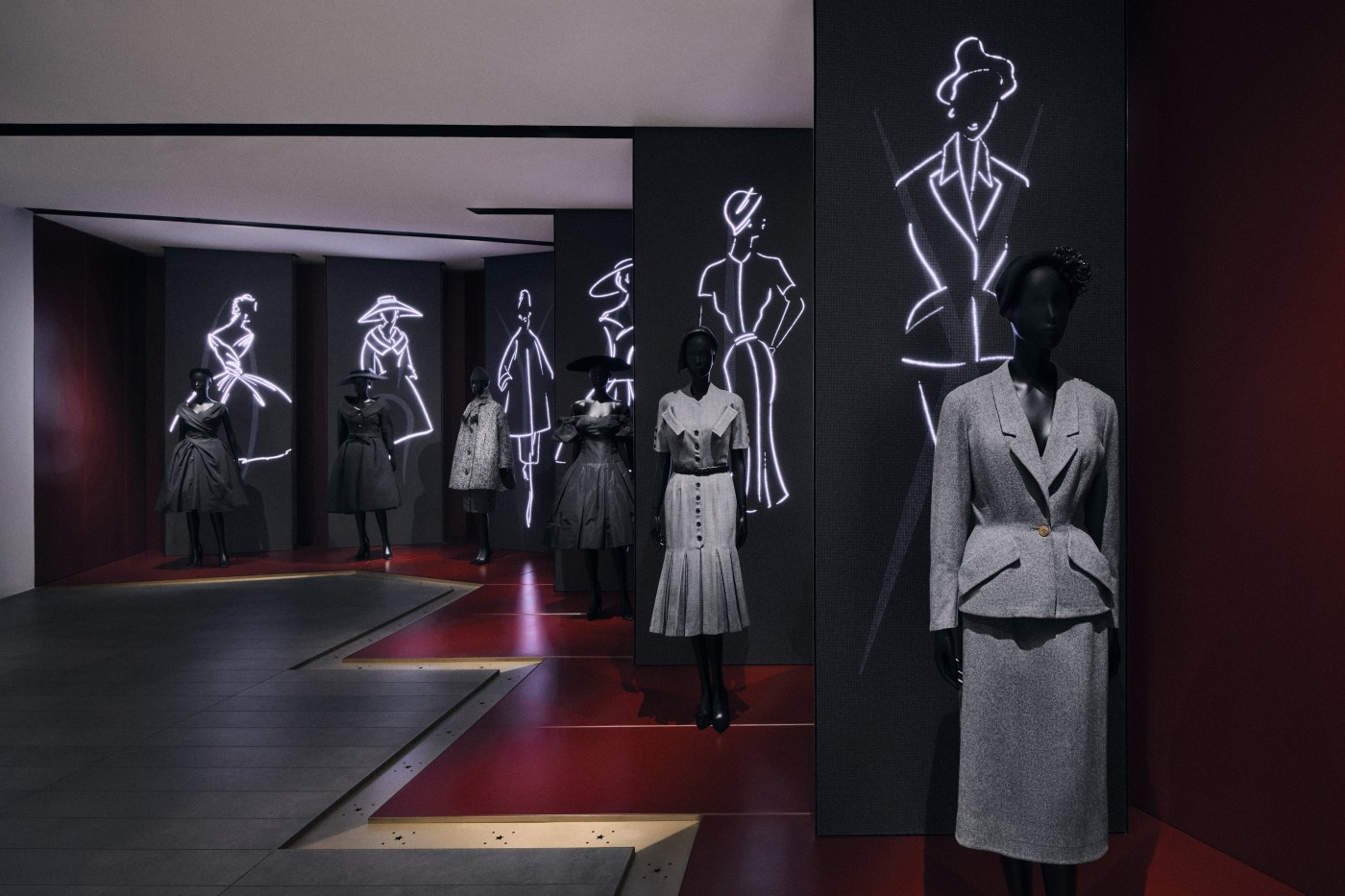
SCENOGRAPHY © ADRIEN DIRAND
As Carla Sozzani, President of the Fondation Azzedine Alaïa, observes, Alaïa collected out of “passion. His idea was to preserve, to help France safeguard its patrimoine.” Acquired largely in secrecy and rarely exhibited, the collection was assembled from auction houses, dealers and private sales. Alaïa gathered haute couture, ready-to-wear and everyday dress spanning the nineteenth century to the present, including works by Dior, Madame Vionnet, Paul Poiret, Jean Patou, Jeanne Lanvin and Charles Frederick Worth, as well as pieces by other doyens of fashion such as Charles James, Mariano Fortuny and Cristóbal Balenciaga, alongside contemporaries including Jean Paul Gaultier, Thierry Mugler, John Galliano and Vivienne Westwood, among many others. The historical patrimony ensemble alone comprises some 15,000 pieces, complemented by approximately 20,000 garments of his own design, along with accessories, drawings and photographs. What distinguishes this extraordinary corpus, Sozzani notes, “is its coherence: everything was chosen by a single eye”, united not by chronology or taxonomy but “because they meant something to him”.
Curator Olivier Saillard, Director of the Fondation Azzedine Alaïa, in collaboration with Gaël Mamine, has conceived two distinct yet complementary exhibitions drawn from some 600 Christian Dior designs held within the archive. Developed as parallel explorations, the exhibition at La Galerie Dior reveals the breadth and nuance of Dior’s practice through Alaïa’s discerning eye as collector, while at the Fondation nearly seventy works by Dior and Alaïa are placed in dialogue, foregrounding not only their shared visual and technical language but also the subtle exchange between their respective practices. Dior, as Sozzani observes, held a special place in Alaïa’s heart: although he worked in the designer’s Avenue Montaigne studio for only a few days when he first arrived in Paris in 1956, he remained deeply influenced by the “atmosphere of the couture and the atelier.”
By bringing Dior and Alaïa into conversation, Saillard draws attention to the formal, conceptual and technical affinities between them, despite the decades that separate their careers. Through juxtapositions that traverse time, he traces a narrative that moves from choices of colour to ornamentation and construction, suggesting that Alaïa’s collecting was not solely an act of preservation but also a measure of his own work against the technical and aesthetic standards of the designers he most admired.
Presented in the grand, glass-roofed gallery that once hosted Alaïa’s own collection shows, the scenography by American artist Kris Ruhs is restrained and refined, allowing the garments to speak both for themselves but also in dialogue with one another and with the surrounding architecture. Nowhere is this more compelling than in the pairing of Dior’s strapless ecru cotton tulle underdress with boned bodice (Haute Couture, Spring–Summer, 1956) and Alaïa’s strapless white cotton voile ruched dress (Spring–Summer, 2006), which brings the hidden architecture of the 1950s underdress decisively to the surface. Equally arresting is the dialogue between Alaia’s formal afternoon dress in red silk faille (Haute Couture, 1958) and Dior’s cocktail dress in red silk satin (Boutique, ca. 1957), a pairing that reads as both homage and a mediation on form and construction.
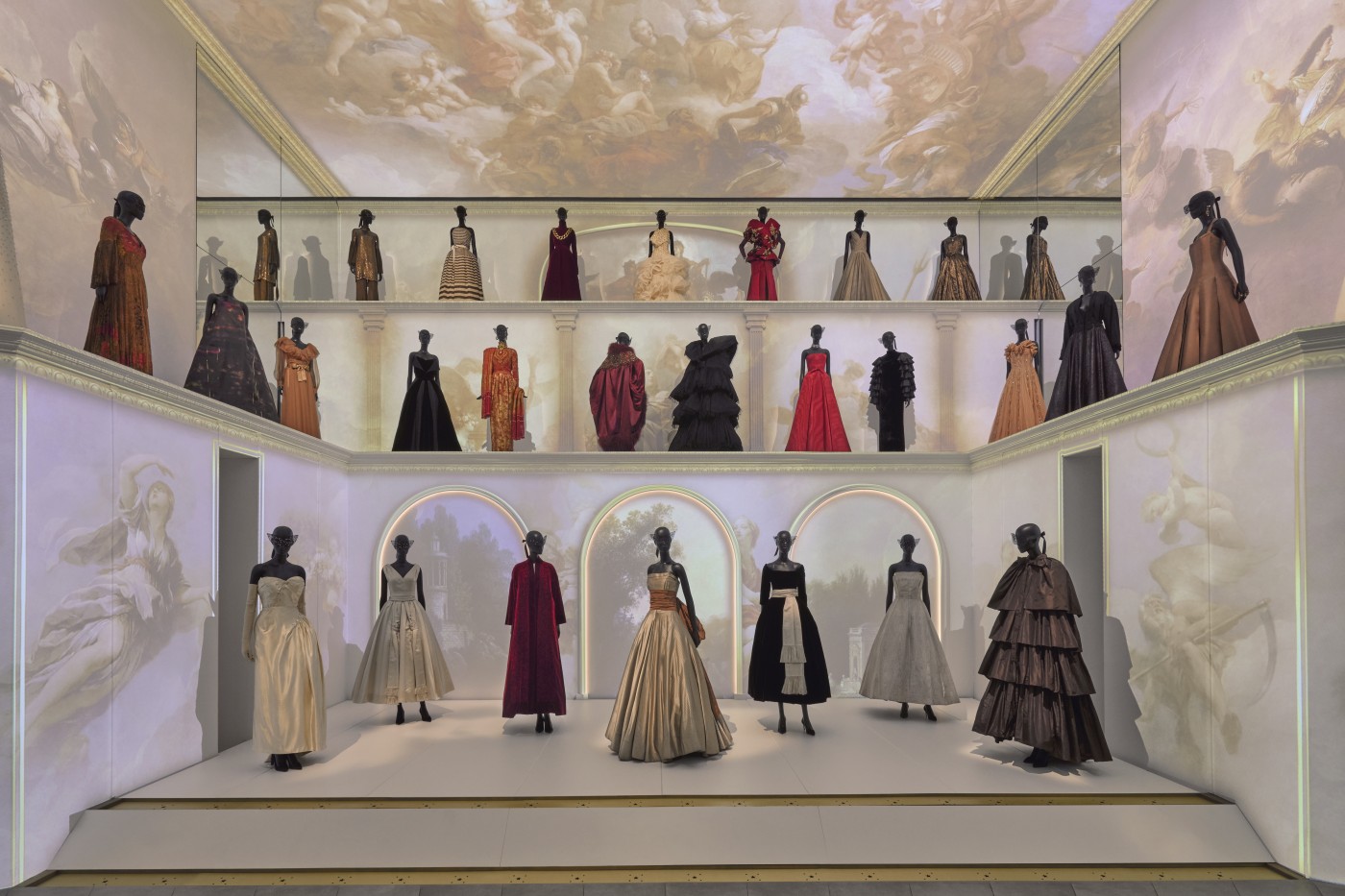
SCENOGRAPHY © ADRIEN DIRAND
At La Galerie Dior, the exhibition adopts a more linear narrative, unfolding through a sequence of thematic chapters and featuring around one hundred works from the archives. The journey begins with an introduction to Christian Dior (1905–1957) and continues through sections such as Enchanted Gardens, The Dior Allure, 30 Avenue Montaigne, The Heart of Creation, A Story of Dresses, The Dior Palette, Ateliers of Dreams, Dior’s Gold, The Architecture of a Dress, The Dior Ball, The Room of Wonders, Miss Dior, and Stars in Dior. The scenography, conceived by Agence NC under the direction of Nathalie Crinière—who was also responsible for the Musée des Arts Décoratifs’ landmark 2018 exhibition Christian Dior, Couturier du Rêve—employs a recognisably similar visual language. While elegant and meticulously composed, its aesthetic continuity with earlier Dior displays risks, for visitors already familiar with those exhibitions, a certain sense of repetition.
The emphasis remains so firmly on following the familiar arc of Dior historiography—origins, genius, signature silhouettes, triumph, celebrity and legacy—that the curatorial potential of the encounter is not fully realised. The opportunity to foreground the particular nature of Alaïa’s collecting practice and to articulate the deeper narrative of how and why these works entered his archive, feels somewhat neglected. As a result, the story of Alaïa as collector, so central to the conceptual premise, recedes, when it might instead have provided the exhibition’s most distinctive thread, allowing visitors to encounter Dior through a different lens.
Nonetheless, the scope and breadth of this private collection, much of it rarely, if ever, publicly displayed, is astonishing, encompassing a remarkable range of designs that testify to both the diversity of Dior’s practice and the acuity of Alaïa’s eye as a collector, as well as his broader interest in the lineage of the house. The selection spans from refined evening gowns to celebrated couture models such as the day coat designed by Dior for Robert Piguet (Haute Couture, circa 1939–1940), Roses des vents (Haute Couture, Spring–Summer, 1950), Carmen (Haute Couture, Autumn–Winter, 1951), Muriel (Haute Couture, Spring–Summer, 1953), Cygne noir (Haute Couture, Autumn–Winter, 1957), Nuit d’Ispahan by Yves Saint Laurent for Dior (Haute Couture, Spring-Summer, 1960) and evening ensemble by Marc Bohan for Dior (Haute Couture, Autumn-Winter, 1961, Charme 62 line).
Seen together, these works reveal not only the stylistic richness of the House of Dior but also the discriminating sensibility that guided Alaïa’s acquisitions, underscoring his fascination with construction, proportion and line across decades of couture, as well as his attentiveness to designers who worked within, and extended, the Dior atelier tradition.
Many years after Alaïa had established his reputation, he was approached to succeed Gianfranco Ferré as creative director of Dior. He declined the offer, choosing instead to preserve the independence that had long defined his practice. As Sozzani notes, by the time such overtures were made, he had already spent decades quietly assembling his own archive: he began collecting Dior garments in 1968, long before the house itself formally undertook systematic efforts to preserve its heritage some twenty years later. The irony is telling. While Dior sought a successor, Alaïa had, in effect, already been engaging in a sustained dialogue with its history through the discerning eye of a couturier and collector.
The exhibitions are on view at the Fondation Azzedine Alaïa until 24 May 2026, and La Galerie Dior until 17 May 2026, respectively.
To explore more Alaïa revisit our News Editor, Dr Babette Radclyffe-Thomas', review of Foundation Azzedine Alaïa's exhibition 'Alaïa / Kuramata: Lightness in Creation' on our blog.
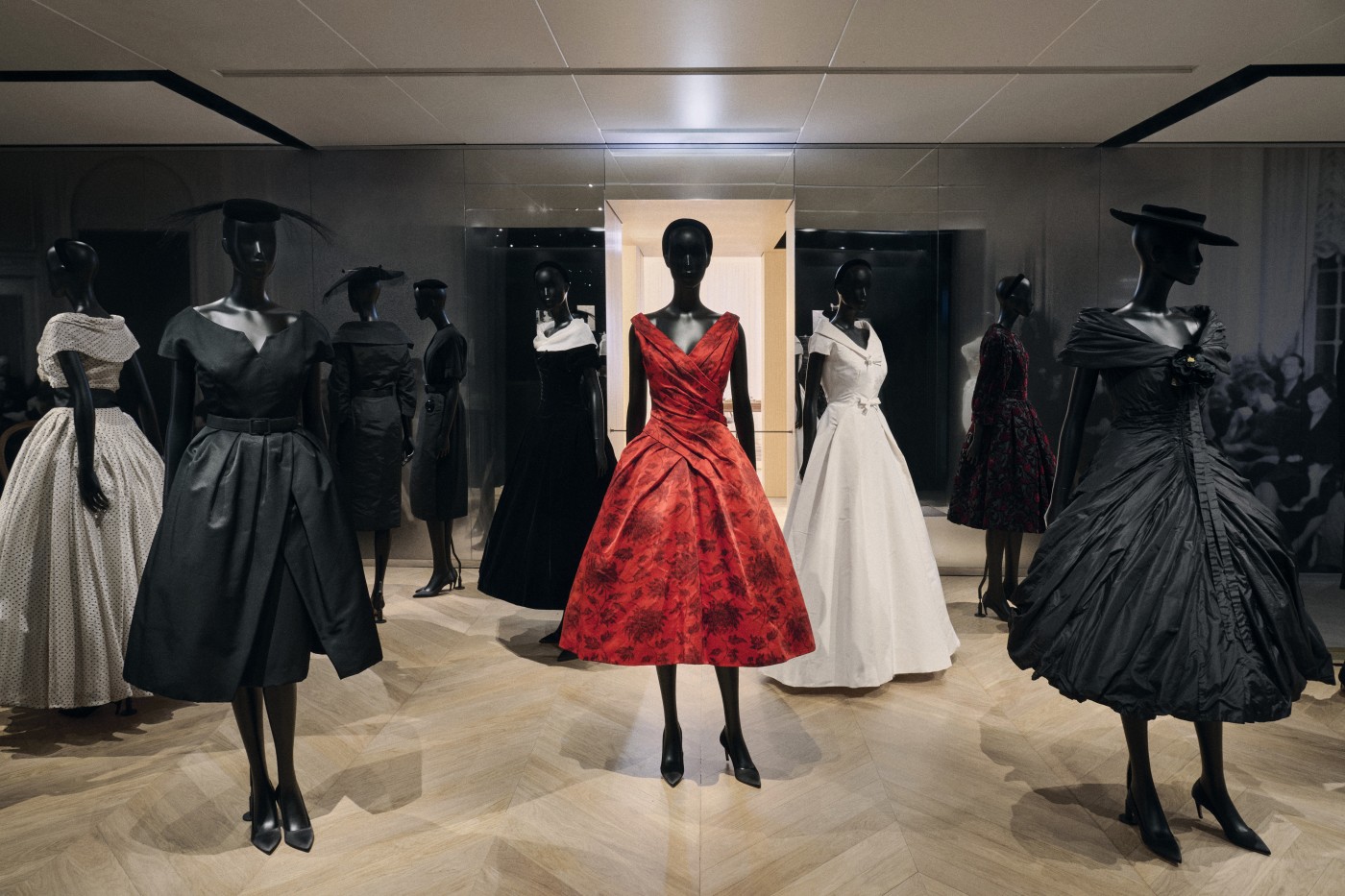
SCENOGRAPHY © ADRIEN DIRAND