- youtube
- bluesky

- Home
- About
- Costume Journal
- Membership
- Conference & Events
- Grants & Awards
- News & Social
In this week’s blog post, Costume Society member Dolla Merrillees reviews Tisser, broder, sublimer: Les savoir-faire de la mode (Weave, embroider, embellish: The craftsmanship of fashion) at Musée de la Mode de la Ville de Paris, Palais Galliera (until 18 October 2026).
Collection-based exhibitions often feel quieter than blockbuster shows, yet they offer a museum the opportunity to speak most clearly in its own voice. For the Palais Galliera, whose holdings number close to 200,000 works—garments, accessories, fashion archives, photographs and drawings—Tisser, broder, sublimer is not only an opportunity “to demonstrate the richness and diversity of its collections from the eighteenth century to the present day, but also to encourage visitors…to observe, scrutinise and question the artisans and artists who contributed to their creation, whether through manual skill or mastery of machinery,” observes curator Marie-Laure Gutton.
Taking as its point of reference the 1981 exhibition, Fashion and Its Trades from the 18th Century to the Present Day and its emphasis on the “finely crafted object,” the exhibition brings together more than 350 works, including clothing, accessories, photographs, graphic arts, samples and textiles to foreground what Gutton describes as the “multitude of contributors who brought their creativity and technical expertise to bear,” from textile designers, seamstresses and embroiderers to plumassiers, lace makers and artificial flower makers.
“Given the multitude of fashion-related skills and crafts, attempting to evoke them all within a single collection-based exhibition would be an impossible challenge,” notes Gutton. Rather than pursuing an exhaustive survey, the exhibition adopts a more considered structure, articulated through three strands—ornamental know-how, cutting and shaping and materials—and organised around the unifying theme of the flower. This, she describes as a “self-evident choice, given the central place of this motif in the decorative arts, particularly in textiles, since the eighteenth century,” one that also reflects the “dynamics of political and colonial expansion, as well as the vitality of the trade networks they generated.”
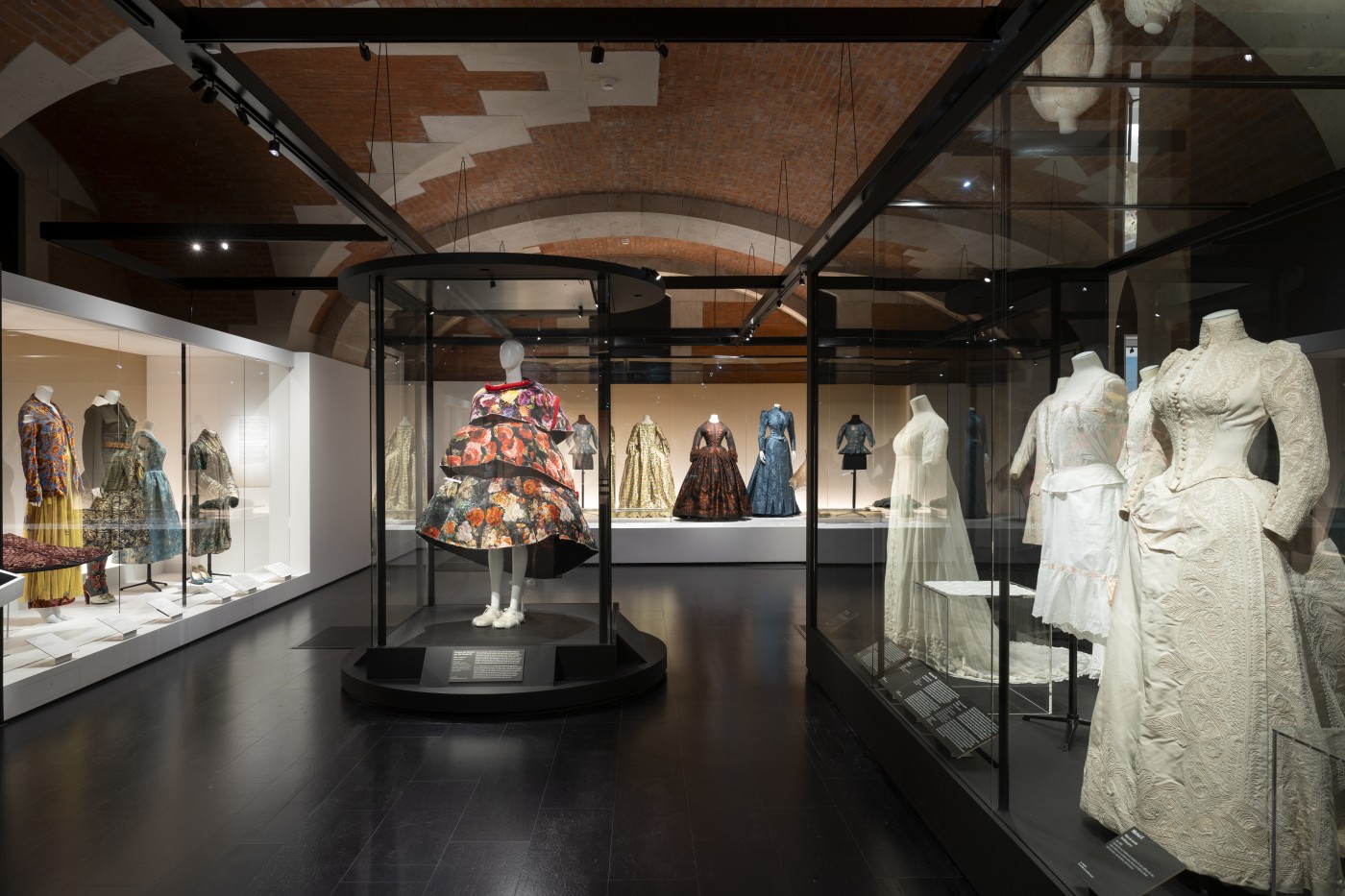
Tisser, broder, sublimer - Palais Galliera, Musée de la Mode de la Ville de Pari © Nicolas Borel
This conceptual framework finds its most compelling expression in the exhibition’s scenographic and curatorial juxtapositions, which bring historical dress into dialogue with contemporary creations by leading haute couture houses and emerging designers. A number of works have been commissioned specifically for the exhibition, including contributions from Lesage, Hurel, Baqué Molinié and Aurélia Leblanc. Particularly effective are the resonances that emerge across the displays, illuminating the diversity of techniques while gesturing to their symbolism and uses: from the brocaded textile of an eighteenth-century waistcoat to a Lurex-woven printed dress by Rei Kawakubo for Comme des Garçons (ready-to-wear, autumn–winter 2016–17); from the intricate embroidery of a Christian Dior evening dress (haute couture, spring–summer 1954) to a Maison Planès silk velvet embroidery sample (circa 1815); from machine made lace in an outfit by Nicolas Ghesquière for Balenciaga (ready-to-wear, spring–summer 2006) to a summer dress with Cluny lace thought to have belonged to Princess Mathilde (1870–72).
Displayed in the museum’s converted basement, with scenography by Sandra Courtine (Ciel Architectes), the installation foregrounds a logic of reuse and adaptation in keeping with the exhibition’s emphasis on both visible craft and unseen labour. It retains and reworks the architectural framework of previous exhibitions while introducing subtle shifts in light and colour. While this approach is commendable, the constraints of the basement galleries inevitably shape the display, at times producing a sense of crowding, with restricted sightlines and a density that can make it difficult to fully view the garments.
In practice, however, while the exhibition purports to foreground craftsmanship and individual makers, what ultimately comes to the fore are the garments and the fashion houses behind them themselves rather than the unseen figures it seeks to highlight. Although several ateliers and artisans are brought into view, such as Andrée Brossin de Méré, Lemarié and Desrues, it reads less as a sustained exploration of métiers than, at times, a sanitised and somewhat romanticised view of the fashion industry. This tendency is further amplified by the pervasive use of the floral theme: while its aesthetic appeal lends charm and coherence to the display, it also risks softening the more complex and contested realities of the industry. This approach is not without precedent. In the Palais Galliera exhibition Gabrielle Chanel: Fashion Manifesto (2020-21), the more controversial aspects of her life and career were similarly left unaddressed, resulting in a narrative that privileged aesthetic achievement over critical complexity.
By ultimately sidestepping the broader realities that underpin this labour, what emerges is a refined homage to savoir-faire but one that remains curiously detached from the conditions in which that labour is performed. There is little acknowledgement of the historical entanglements that have shaped haute couture: the legacies of colonialism and imperialism that structured the flow of materials, skills and wealth; the rigid hierarchies of social class that governed access to both production and consumption; and the gendered nature of atelier work, where generations of predominantly female labourers have operated within systems that have not always proportionately rewarded their skill, and that have long prized discretion and collective anonymity as professional virtues. The exhibition gestures toward the artisan yet stops short of examining the asymmetries that define their position within the fashion economy.
This omission is striking given the well-documented moments of resistance within the French fashion industry. One such example is the protests by seamstresses at Nina Ricci in Paris in 1990s, when workers took to the streets to contest layoffs and defend their livelihoods, an episode that speaks directly to the tension between the image of couture as timeless and the economic realities that render its workforce vulnerable. Such episodes unsettle the exhibition’s portrayal of the atelier as a harmonious site of creation, revealing instead a workplace shaped by the same pressures, negotiations and inequities as any other.
Equally absent is any sustained interrogation of material provenance. Fabrics and embellishments appear largely divorced from the geographies and labour systems that produced them. There is minimal interrogation of the global networks, often historically extractive, through which these materials circulated, nor of the industrial or colonial conditions under which they were made. In this way, the exhibition preserves the illusion of couture as a self-contained world, rather than one that remains deeply embedded in complex and uneven global histories.
What is lost, then, is not simply historical nuance but a fuller understanding of the garment itself. To isolate craftsmanship from its conditions of production is to diminish both. By leaving these dimensions largely unaddressed, the exhibition risks presenting a sanitised and ultimately incomplete narrative. Despite its clear intention to celebrate the métiers, it inadvertently privileges the aesthetic qualities of labour, while the structures that sustain it remain less visible. The result is a form of reverence that, while sincere, hesitates to engage more fully with the complexities and contradictions of its making.
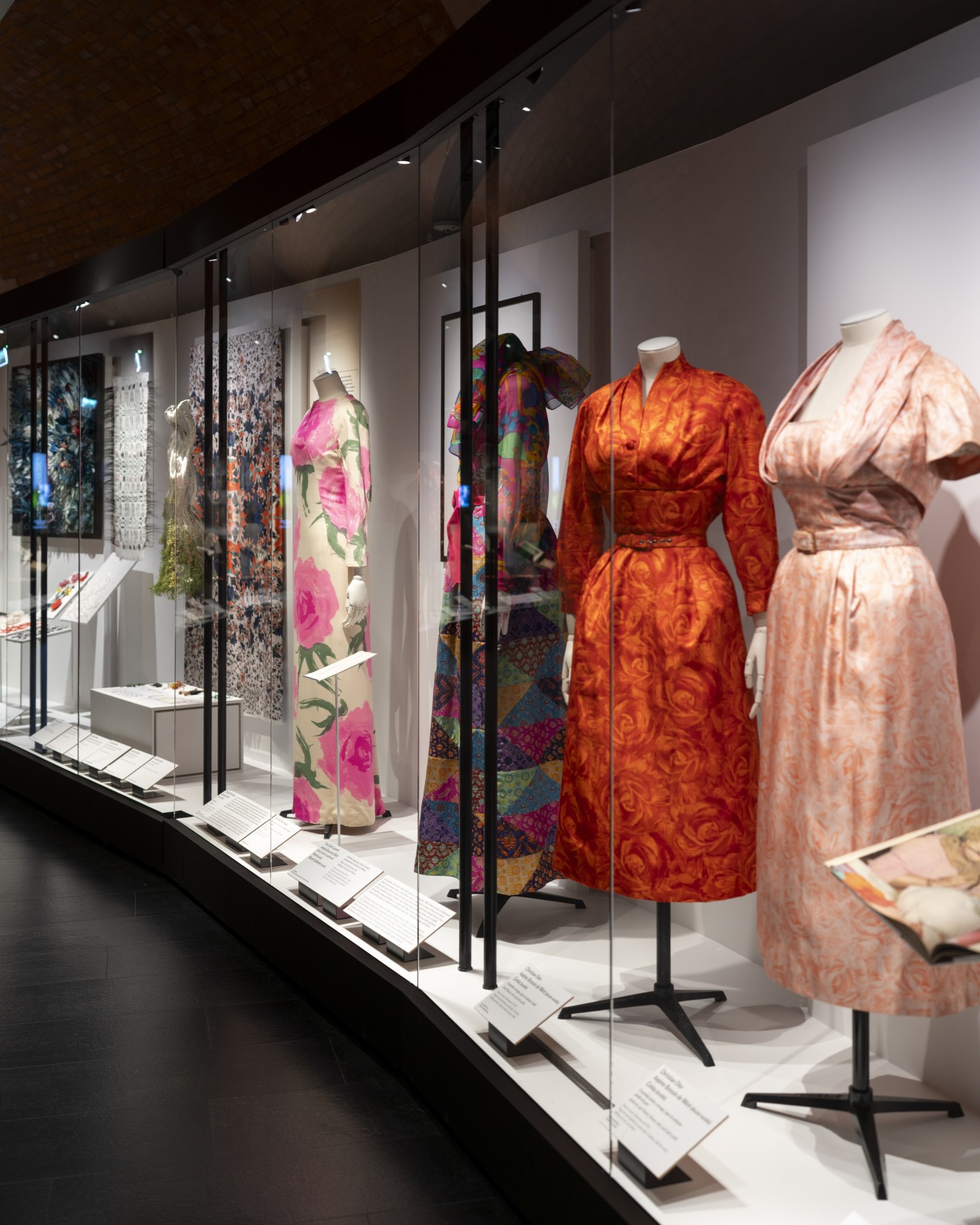
Tisser, broder, sublimer - Palais Galliera, Musée de la Mode de la Ville de Pari © Nicolas Borel
Nonetheless, the exhibition offers a compelling opportunity to encounter the extraordinary breadth of the museum’s collections, a richness that, particularly in the present climate, brings with it a heightened responsibility to move beyond familiar interpretive frameworks and to engage these holdings with greater critical ambition, rather than simply affirm the mythology of couture. As Gutton herself acknowledges, “it becomes a matter of striking a balance between presenting our masterpieces, those expected by visitors, and revealing works that have never before been shown.”
The exhibition is on view at Musée de la Mode de la Ville de Paris, Palais Galliera until 18 October 2026.
Dolla has recently visted other exhibitions in Paris, including the Poiret retrospective at Musée des Arts décoratifs. You can revisit her review on our blog.